
Connecting an enclosed trailer involves more than placing the coupler over a hitch ball.
The tow vehicle, receiver hitch, ball mount, hitch ball, coupler, safety chains, breakaway system and electrical connector must work together as one complete towing system.
This guide explains how the major components fit together, how to compare ratings and what to inspect before towing.
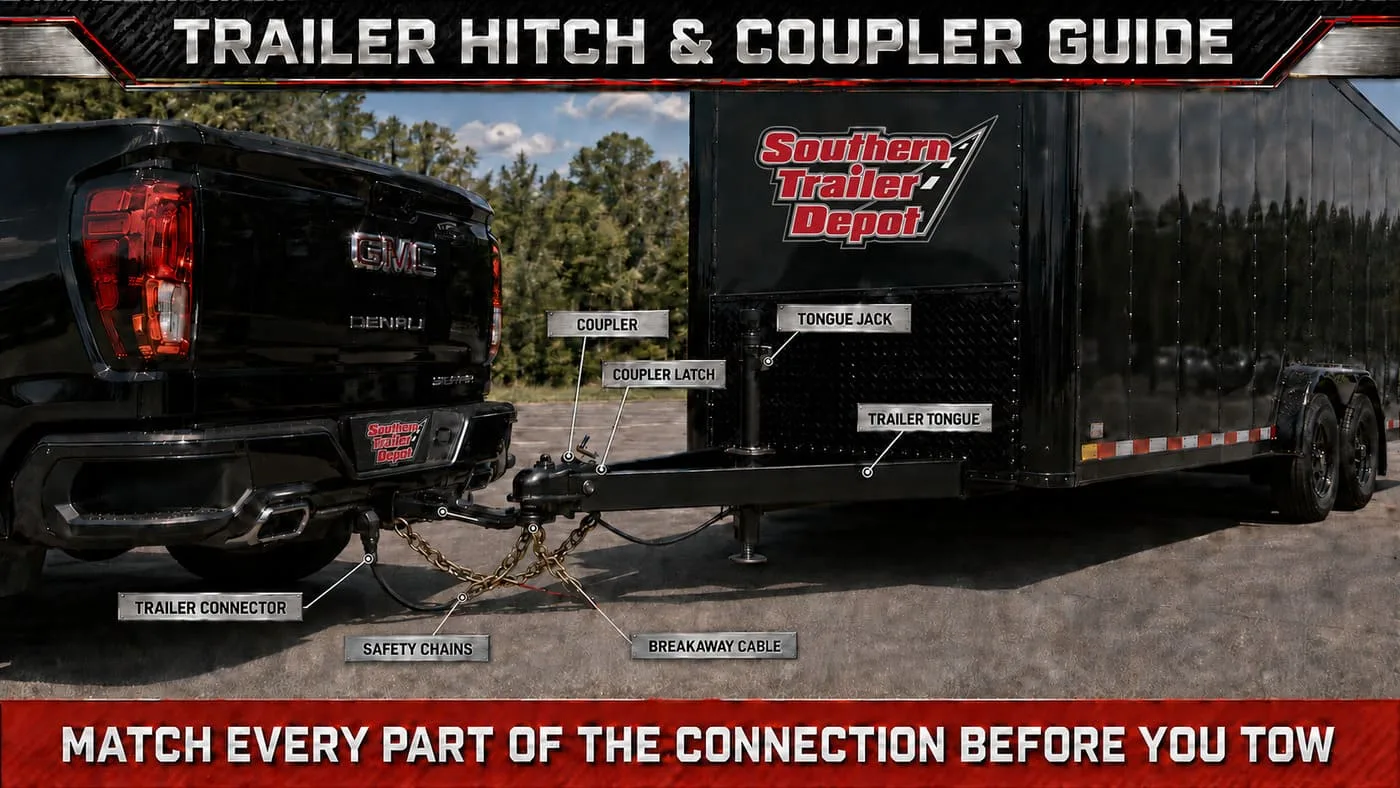
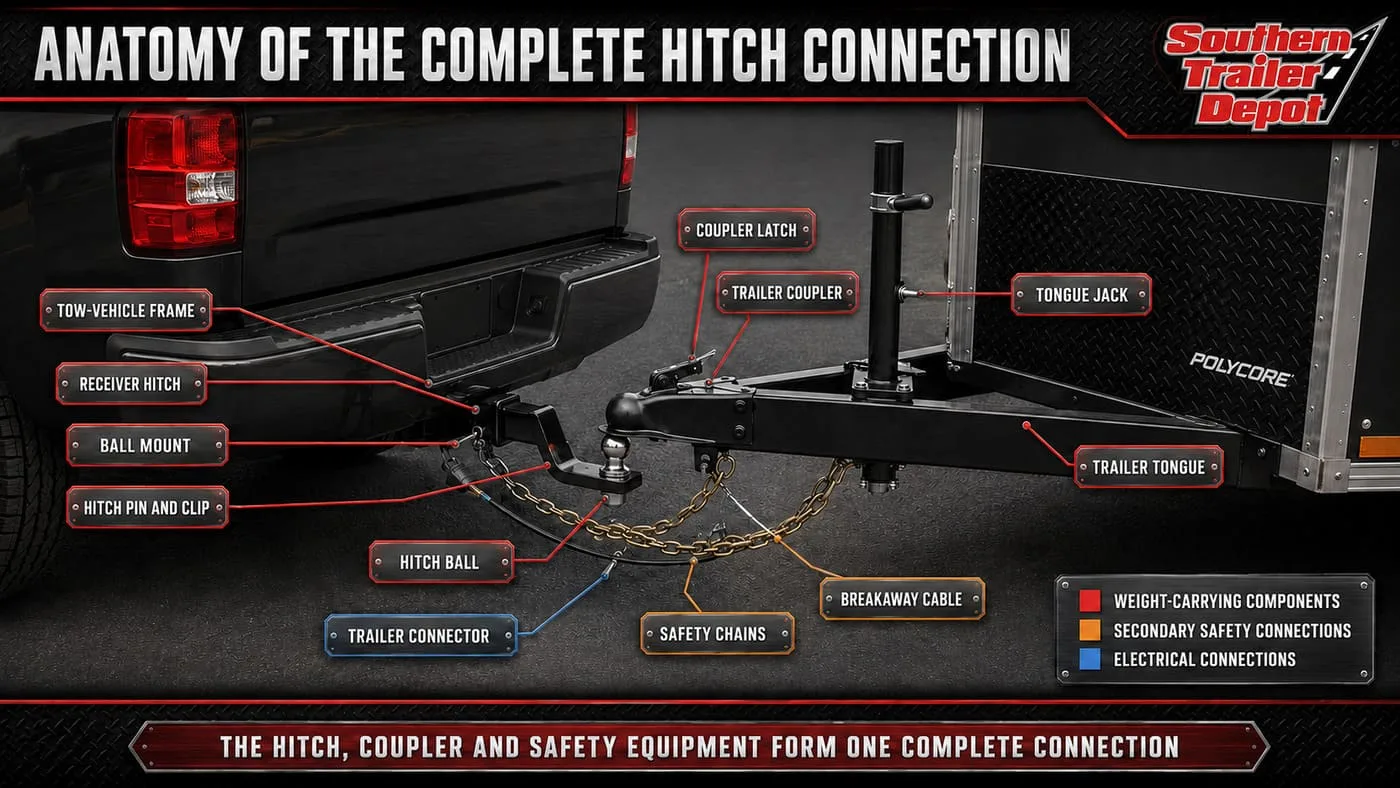
The Complete Trailer Connection
A properly connected trailer uses several components that perform different jobs.
The receiver hitch is attached to the tow vehicle. The ball mount fits inside the receiver and positions the hitch ball at the correct towing height. The trailer coupler fits over the hitch ball and locks in place.
Safety chains provide a secondary connection between the trailer and tow vehicle. The breakaway cable activates the trailer’s breakaway system if the trailer separates from the tow vehicle. The electrical connector supplies the trailer’s road lights and electric-brake circuits.
The tongue jack supports the front of the trailer while it is disconnected, but it must be completely raised and secured before towing.
The complete connection can include:
- ✓Tow-vehicle receiver hitch
- ✓Ball mount
- ✓Hitch pin and retaining clip
- ✓Hitch ball
- ✓Trailer coupler
- ✓Coupler latch and locking device
- ✓Safety chains
- ✓Breakaway switch and cable
- ✓Trailer electrical connector
- ✓Tongue jack
Each component should be compatible with the others and rated for the intended trailer and load.
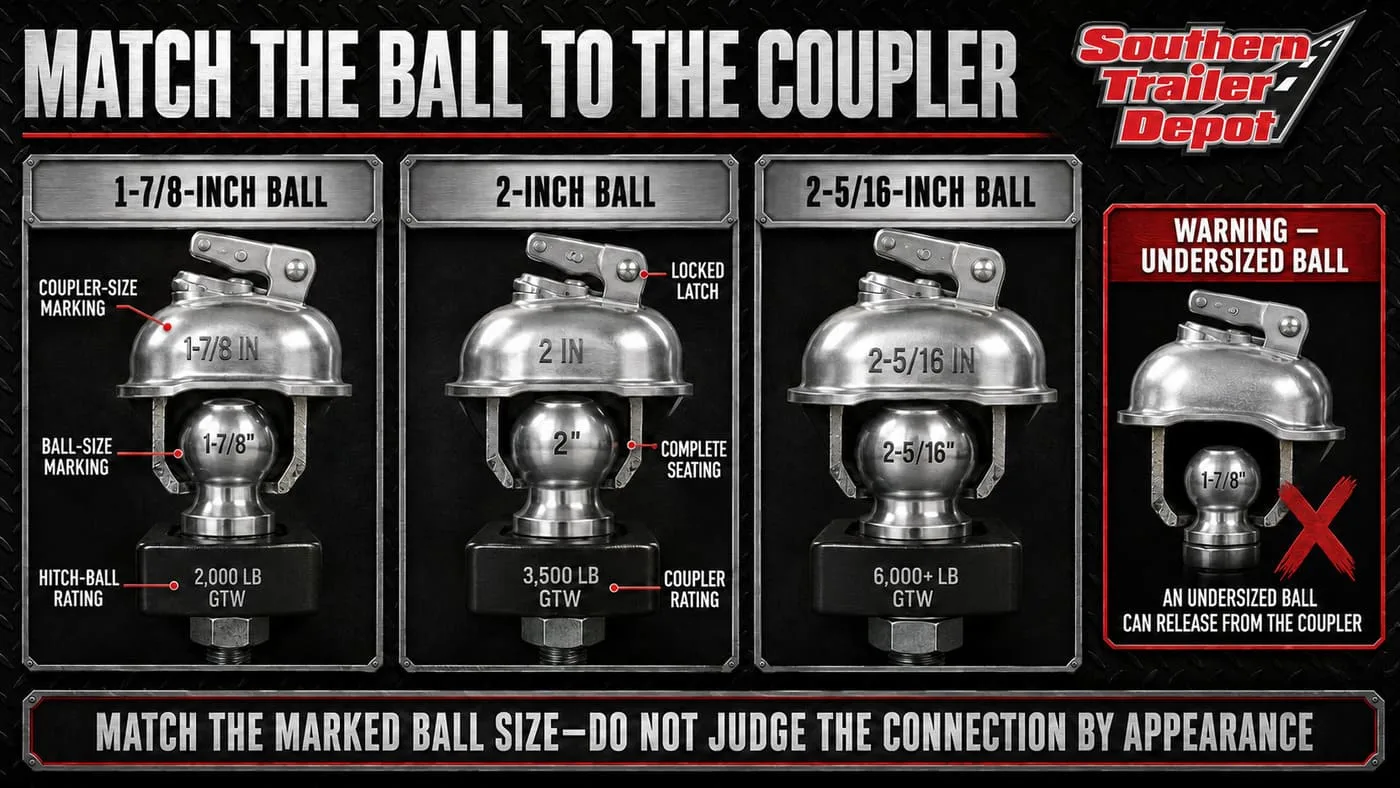
Match the Hitch Ball to the Coupler
The hitch ball must match the size marked on the trailer coupler.
Common hitch-ball sizes include:
- 1-7/8 inch
- 2 inches
- 2-5/16 inches
The correct size cannot be determined from the trailer’s exterior dimensions alone. Two trailers of similar size may use different couplers because of differences in construction, GVWR or intended use.
Look for the required ball size stamped, engraved or labeled directly on the coupler. Also verify the hitch ball’s weight rating.
A smaller hitch ball should never be used as a substitute for the size required by the coupler. A coupler may appear to close over the wrong ball while still being unable to hold the trailer securely.
The coupler should:
- ✓Match the hitch-ball size
- ✓Seat completely over the ball
- ✓Close and lock correctly
- ✓Remain secure when tested
- ✓Have an adequate weight rating
- ✓Show no cracks, bending or excessive wear
IMPORTANT: If the ball size, rating or coupler condition cannot be confirmed, do not tow until the connection has been properly inspected.
Common Enclosed-Trailer Coupler Styles
A-Frame Coupler
An A-frame coupler is mounted where the two sides of an A-frame trailer tongue meet. This design is common on enclosed bumper-pull trailers.
Straight-Tongue Coupler
A straight-tongue coupler mounts to a single trailer-tongue section. It is more commonly found on smaller or lighter trailer configurations.
Adjustable-Channel Coupler
An adjustable coupler mounts inside a vertical channel and can be repositioned to help match the trailer to the tow vehicle’s hitch height. The coupler must be installed with the correct hardware, in an approved position and according to the trailer or component manufacturer’s requirements.
Gooseneck Coupler
A gooseneck trailer connects to a hitch ball mounted in or above the tow vehicle’s bed. This is a different connection system from a conventional bumper-pull receiver hitch.
Always confirm which coupler design is installed before selecting the hitch equipment.
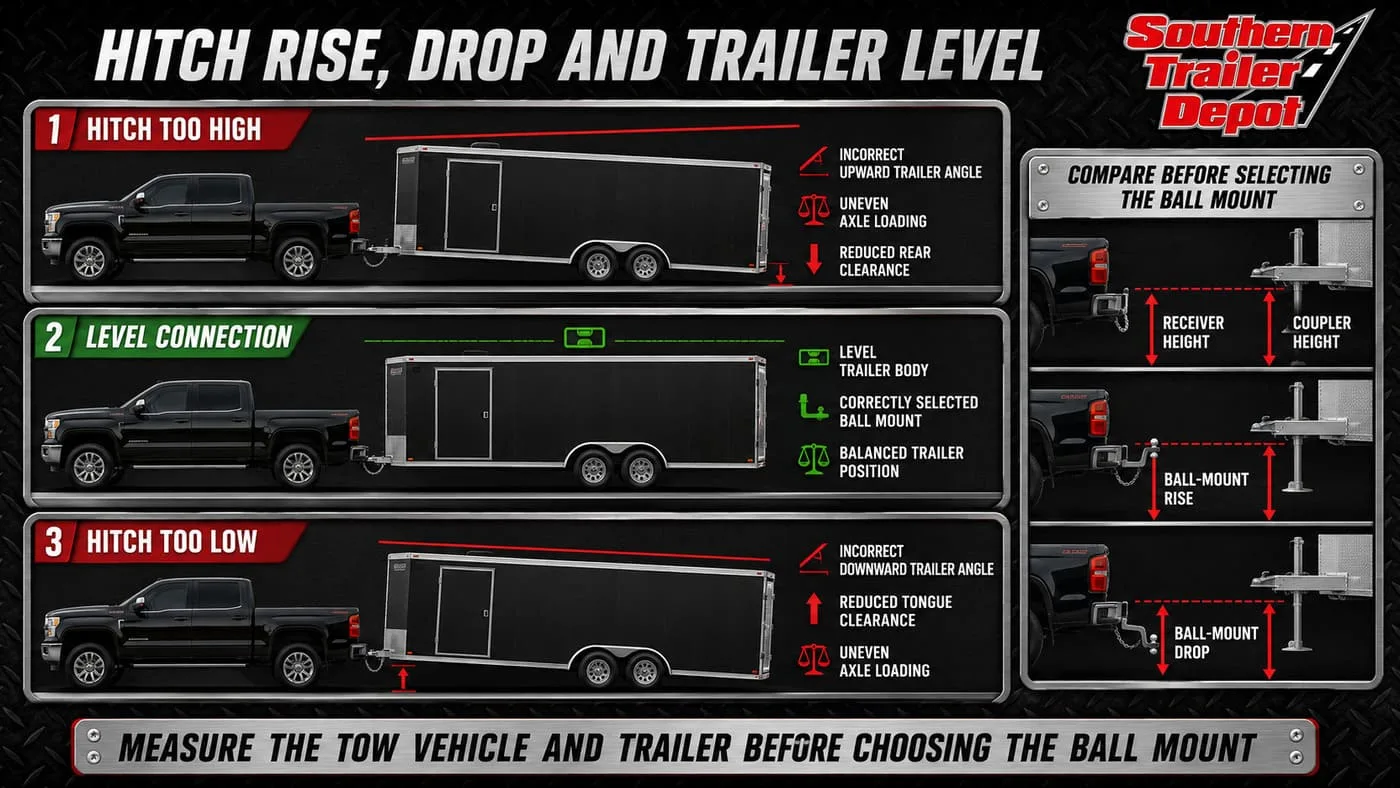
Keep the Trailer Level
A trailer should normally sit level when connected and loaded for travel, unless the trailer or tow-vehicle manufacturer specifies otherwise.
If the hitch ball is too high, the front of the trailer may ride higher than the rear. If it is too low, the trailer may point downward toward the tow vehicle.
An improperly positioned trailer can affect:
- ✓Axle loading
- ✓Tire loading
- ✓Ground clearance
- ✓Rear ramp clearance
- ✓Braking behavior
- ✓Trailer stability
- ✓Tow-vehicle handling
The required ball-mount rise or drop depends on the loaded height of the tow vehicle and the level coupler height of the trailer.
Suspension changes, larger tires, cargo weight and tow-vehicle loading can all affect these measurements.
IMPORTANT: Do not choose a ball mount entirely from an unloaded visual estimate. Measure the tow vehicle and trailer on a reasonably level surface.
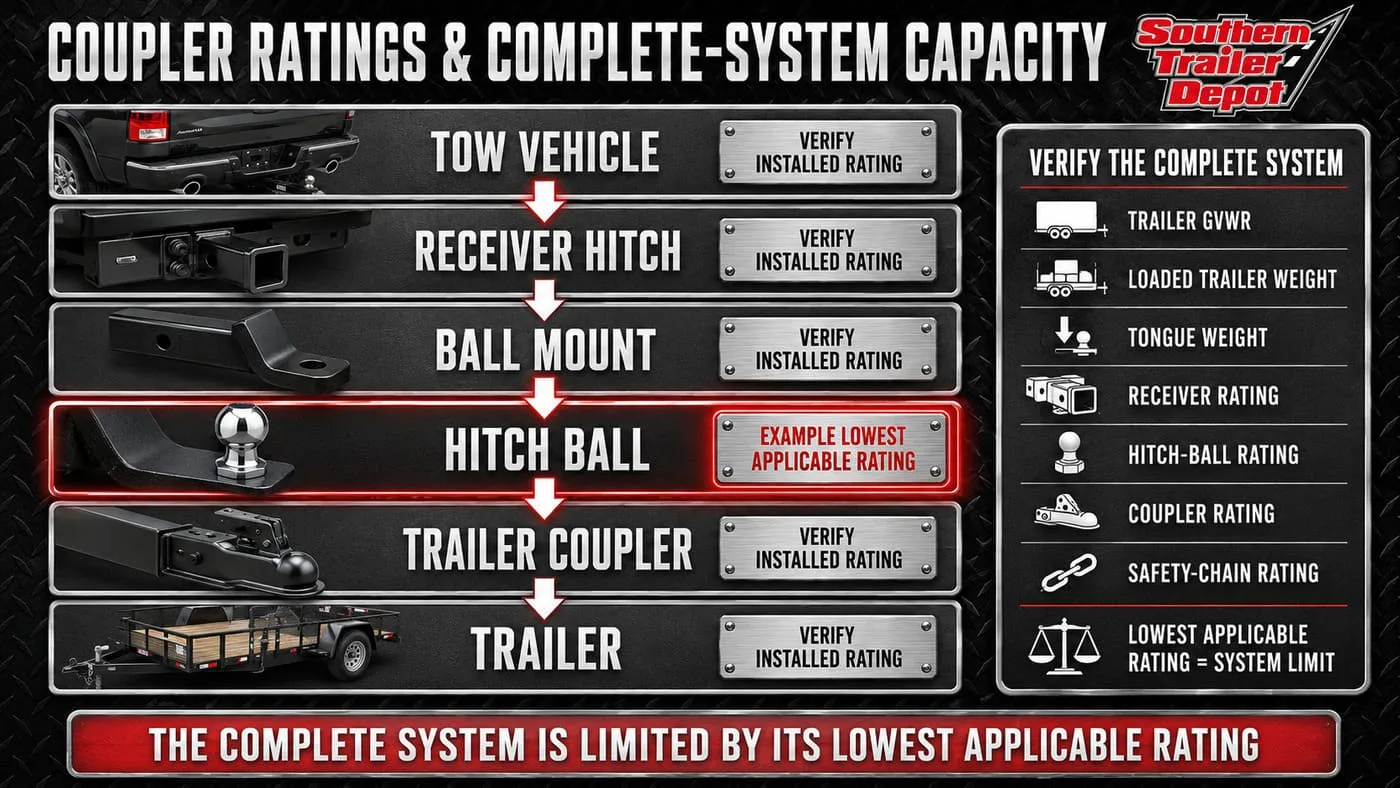
The Lowest-Rated Component Limits the System
A heavy-duty coupler does not increase the capacity of every other towing component.
The complete towing system can include ratings for:
- ✓Tow vehicle
- ✓Receiver hitch
- ✓Ball mount
- ✓Hitch ball
- ✓Coupler
- ✓Safety chains
- ✓Trailer frame
- ✓Axles
- ✓Tires and wheels
- ✓Trailer GVWR
The usable capacity is limited by the lowest applicable rating in the complete system.
For example, installing a hitch ball with a higher rating does not increase the tow-vehicle rating, receiver rating, coupler rating or trailer GVWR.
Never assume that trailer size, axle capacity or the appearance of a heavy-duty hitch determines the completed towing capacity. Verify the ratings shown on the equipment, certification labels and manufacturer information.
Related guide: Trailer Weight Chart
Related guide: GVWR Explained
Safety Chains, Breakaway Cable and Wiring
Safety chains, the breakaway cable and the electrical connector serve different purposes. One does not replace another.
Safety Chains
Attach the safety chains to the tow vehicle’s designated connection points.
The chains need enough length for normal turns without binding, but they should not drag on the road. Arrange or cross the chains when required by the component manufacturer or applicable regulations.
Never attach safety chains to the removable ball mount unless that is an approved connection point.
Breakaway Cable
The breakaway cable operates the trailer’s emergency breakaway switch if the trailer separates from the tow vehicle.
Connect it to a secure tow-vehicle attachment point according to the breakaway-system manufacturer’s instructions. Do not wrap it around the hitch ball or connect it in a way that prevents it from activating properly.
The breakaway battery must also be charged, connected and maintained.
Electrical Connector
The electrical connector supplies the trailer’s road-light circuits and, when equipped, the electric-brake circuit.
Route the cable with enough slack for turns, but keep it away from:
- ✓The road
- ✓Sharp edges
- ✓The coupler latch
- ✓Safety-chain hooks
- ✓Moving hitch components
- ✓Excessive heat
Test the trailer lights and electric brakes before the trip.
Related guide: Trailer Brake Guide
Related guide: Enclosed Trailer Electrical Guide
How to Connect an Enclosed Trailer
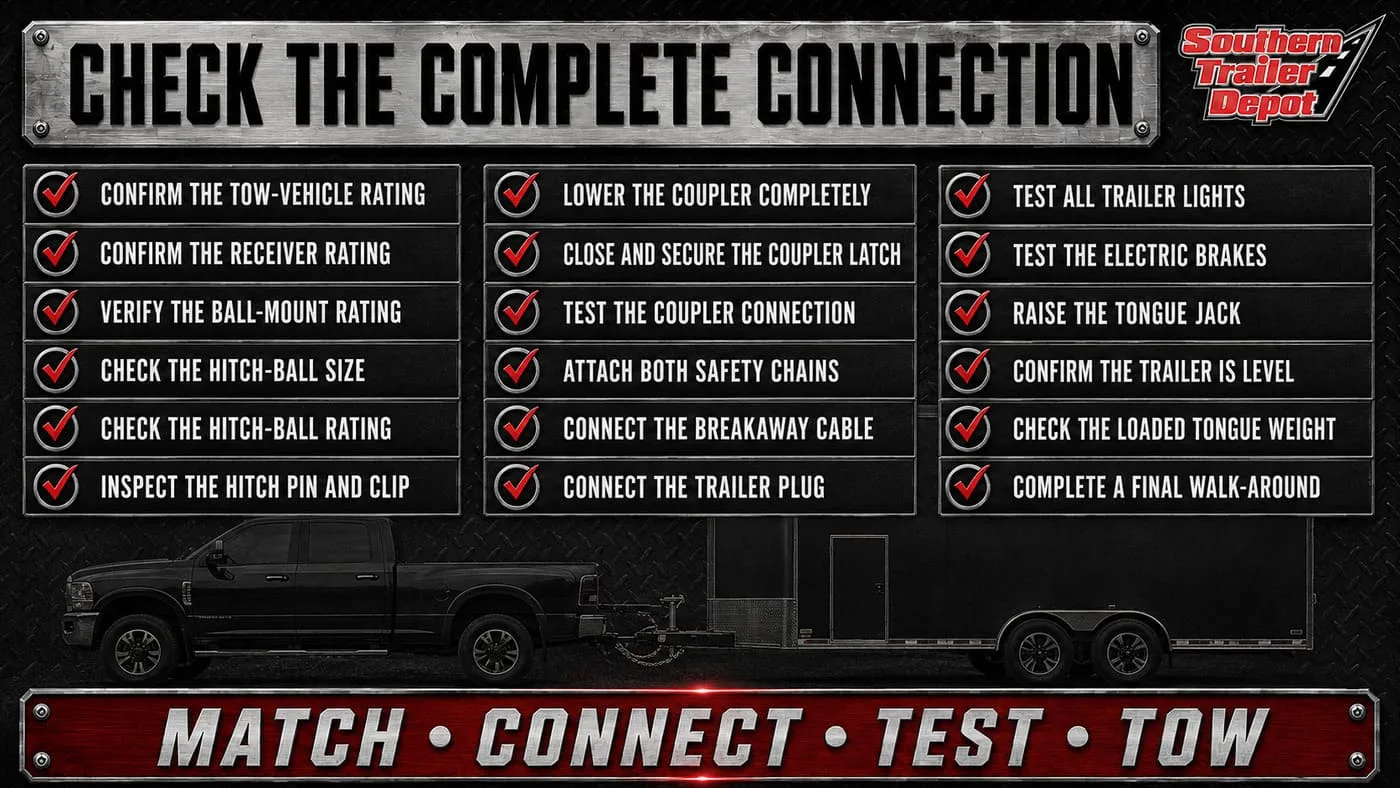
Always follow the instructions for the installed coupler, hitch and tow vehicle. A typical connection process includes the following steps:
- Park the tow vehicle and trailer on a stable surface.
- Confirm the required hitch-ball size.
- Verify the ratings of the hitch, ball mount, ball and coupler.
- Position the hitch ball directly beneath the coupler.
- Lower the coupler completely onto the hitch ball.
- Close and secure the coupler latch.
- Test the connection before raising the jack completely.
- Attach both safety chains.
- Connect the breakaway cable independently.
- Insert the trailer’s electrical connector.
- Raise and secure the tongue jack.
- Check the trailer’s running lights, turn signals and brake lights.
- Test the electric brakes and brake controller.
- Confirm that the trailer sits level.
- Complete a final walk-around inspection.
IMPORTANT: Never place hands or feet beneath the coupler while positioning or lowering the trailer.
After connecting, use the tongue jack to apply a small upward test load when appropriate for the coupler design. This helps confirm that the locked coupler remains securely attached to the hitch ball.
Correct Connection vs. Common Mistakes
A connection may look complete while still containing a serious problem.
Common hitch and coupler mistakes include:
- ✗Using the wrong hitch-ball size
- ✗Failing to close the coupler latch completely
- ✗Forgetting the coupler pin or lock
- ✗Using an underrated ball mount
- ✗Allowing safety chains to drag
- ✗Connecting the breakaway cable to the wrong location
- ✗Leaving too little wiring slack for turns
- ✗Leaving the tongue jack partially lowered
- ✗Towing with the trailer noticeably nose-high or nose-low
- ✗Assuming axle capacity determines the trailer’s GVWR
- ✗Exceeding the tow vehicle’s limits
- ✗Failing to test the lights and brakes
Stop and correct the connection if any part appears loose, damaged, incorrectly routed or incompatible.
Match the Tow Vehicle to the Complete Load
Selecting the correct hitch equipment does not guarantee that the tow vehicle can safely tow the trailer.
The tow vehicle must be evaluated using the manufacturer’s ratings and the completed loaded condition.
Consider:
- ✓Maximum trailer rating
- ✓Receiver-hitch rating
- ✓Tow-vehicle payload
- ✓Gross combined weight rating
- ✓Loaded trailer weight
- ✓Tongue weight
- ✓Passenger weight
- ✓Cargo carried inside the tow vehicle
- ✓Installed accessories
- ✓Brake-controller requirements
Trailer upgrades also add weight before cargo is loaded. Cabinets, flooring, batteries, air conditioning, generators, spare tires and electrical equipment reduce the remaining payload available for cargo.
Review the tow-vehicle owner’s manual, certification labels and manufacturer instructions before selecting the trailer or towing equipment.
Related guide: Trailer Tongue Weight and Proper Loading Guide
Related guide: Cargo Trailer Buyer’s Guide
Inspect the Connection Before Every Trip
Hitch and coupler components experience movement, weather exposure, road debris and repeated loading.
Before towing, check for:
- ✓Cracks
- ✓Bent components
- ✓Excessive coupler movement
- ✓Loose mounting hardware
- ✓Damaged welds
- ✓Missing pins or clips
- ✓Coupler-latch problems
- ✓Worn hitch-ball surfaces
- ✓Rust or corrosion
- ✓Damaged safety chains
- ✓Damaged breakaway cable
- ✓Exposed or pinched wiring
- ✓Loose electrical connection
- ✓An improperly raised tongue jack
IMPORTANT: If the coupler does not close, lock or remain seated correctly, stop and have the system inspected. Do not tow with a cracked receiver, damaged coupler, missing safety equipment or questionable frame weld.
Related guide: Enclosed Trailer Maintenance Guide
Choose a Trailer Around the Complete Load
The correct trailer connection begins with selecting a trailer that matches the cargo, tow vehicle and intended use.
Southern Trailer Depot offers enclosed cargo trailers for work, motorcycles, vehicles, equipment, recreation and custom commercial applications.
Our team can help you compare:
- ✓Trailer sizes
- ✓Axle packages
- ✓GVWR configurations
- ✓Coupler options
- ✓Interior dimensions
- ✓Rear openings
- ✓Loading access
- ✓Tie-down systems
- ✓Electrical packages
- ✓Finished interiors
- ✓Custom upgrades
The final trailer and towing setup must still follow the tow-vehicle, trailer and component manufacturers’ requirements.
Ready to Plan Your Next Trailer?
Tell us what you need to carry, how much it weighs and how the trailer will be used. We’ll help you compare available inventory and custom-order options.
Important Safety Notice
Trailer configurations, hitch requirements, ratings and towing limits vary.
Always follow the instructions and ratings provided by the tow-vehicle, trailer, hitch, coupler, axle, brake and component manufacturers. Comply with all applicable federal, state and local towing requirements.
Do not tow if any component is damaged, improperly connected, incompatible or inadequately rated.
Frequently Asked Questions
How do I know which hitch-ball size my trailer needs?
Look for the required ball size stamped, engraved or labeled on the trailer coupler. Do not determine the ball size from the trailer’s exterior dimensions or appearance.
Can I use a 2-inch hitch ball with a 2-5/16-inch coupler?
No. The hitch ball must match the size required by the coupler. An undersized ball can allow excessive movement or trailer separation even if the coupler latch appears to close.
Does a higher-rated hitch ball increase towing capacity?
No. Installing a higher-rated hitch ball does not increase the ratings of the tow vehicle, receiver, ball mount, coupler or trailer. The complete system remains limited by its lowest applicable rating.
Should an enclosed trailer sit level while towing?
An enclosed trailer should generally sit level when connected and loaded unless the manufacturer specifies otherwise. An incorrect hitch height can affect axle loading, ground clearance, handling and stability.
How much slack should safety chains have?
Safety chains need enough slack for the tow vehicle and trailer to complete normal turns without binding. They should not be so long that they drag on the road. Follow the chain, hitch and trailer manufacturer’s instructions.
Where should the breakaway cable be connected?
Attach the breakaway cable to a secure tow-vehicle connection point as directed by the breakaway-system manufacturer. It should be attached independently and routed so it can activate the switch if the trailer separates.
Is the trailer plug part of the breakaway system?
The trailer plug and breakaway system perform different functions. The plug carries the normal lighting and electric-brake circuits. The breakaway system uses a separate switch and onboard battery to activate the trailer brakes during a separation.
How often should I inspect the hitch and coupler?
Inspect the complete connection before every trip. Periodically inspect the receiver, ball mount, hitch ball, coupler, safety chains, breakaway equipment, mounting hardware and wiring for wear or damage.
Can every tow vehicle use a weight-distribution hitch?
No. A weight-distribution system should only be used when it is compatible with and approved for the tow vehicle, receiver hitch, trailer frame and installed components. Follow all manufacturer requirements.