
Towing an enclosed trailer safely requires more than connecting the coupler and checking whether the truck can pull it.
The tow vehicle, hitch, coupler, loaded trailer weight, tongue weight, brakes, tires and cargo placement must work together. A trailer that is incorrectly loaded or connected can become unstable even when its total weight appears to fall within the tow vehicle’s advertised rating.
This enclosed trailer towing guide explains how to evaluate:
- ✓Tow-vehicle capacity
- ✓Gross vehicle weight rating
- ✓Loaded trailer weight
- ✓Payload
- ✓Tongue weight
- ✓Hitch and coupler ratings
- ✓Brake-controller operation
- ✓Weight-distribution equipment
- ✓Cargo placement
- ✓Trailer sway
- ✓Tire condition and pressure
- ✓Pre-trip safety
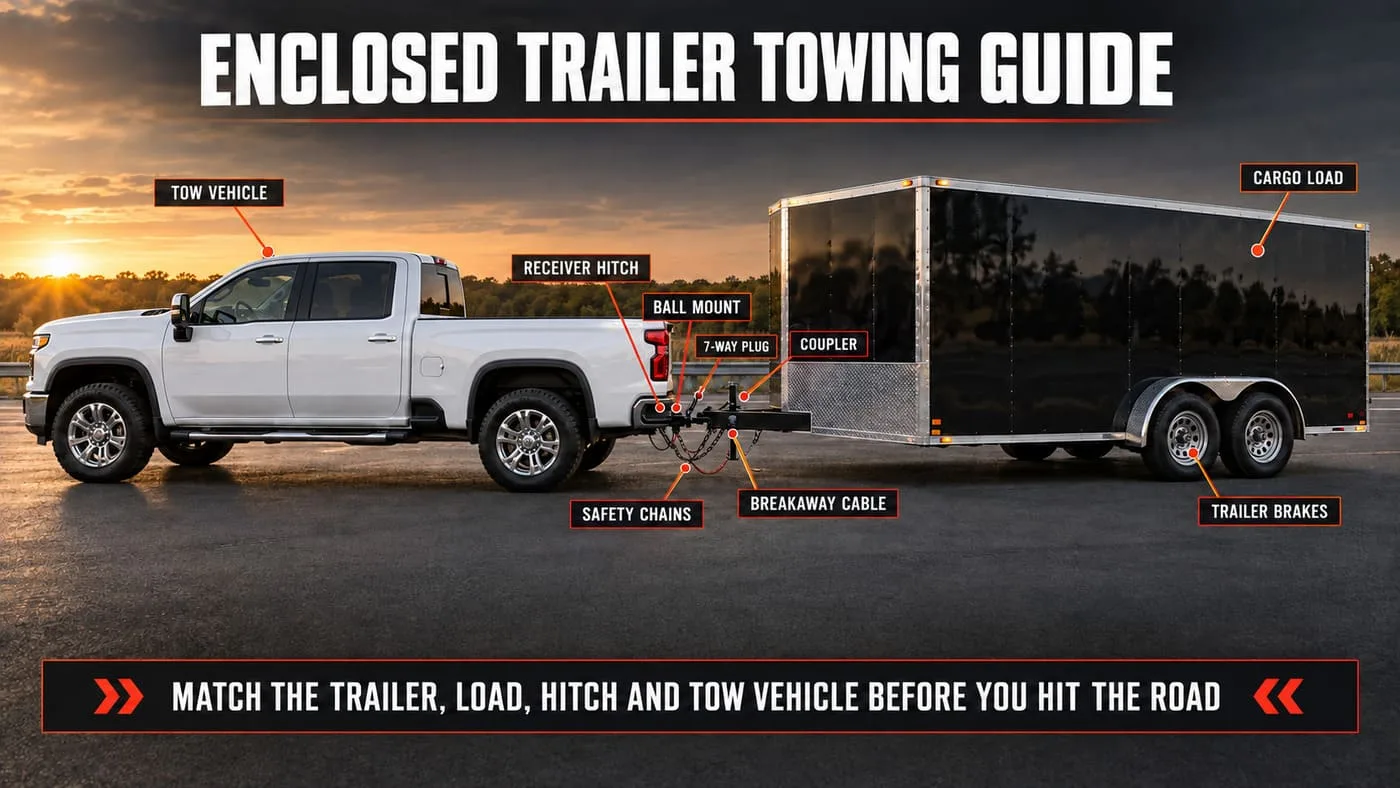
Start With the Complete Towing Combination
Safe towing depends on the entire combination—not one advertised number.
The towing combination includes:
- ✓Tow vehicle
- ✓Receiver hitch
- ✓Ball mount
- ✓Hitch ball
- ✓Trailer coupler
- ✓Safety chains
- ✓Breakaway system
- ✓Trailer axles
- ✓Trailer tires and wheels
- ✓Trailer brakes
- ✓Cargo and equipment
- ✓Driver and passengers
- ✓Cargo carried inside the tow vehicle
Every major component must be properly rated for the actual load. The lowest-rated component can limit the capacity of the entire setup.
A truck with a high advertised towing capacity does not automatically make every trailer safe to tow. The vehicle’s payload rating, receiver rating, hitch configuration, passengers, cargo and tongue weight must also be considered.
Important Trailer and Tow-Vehicle Ratings
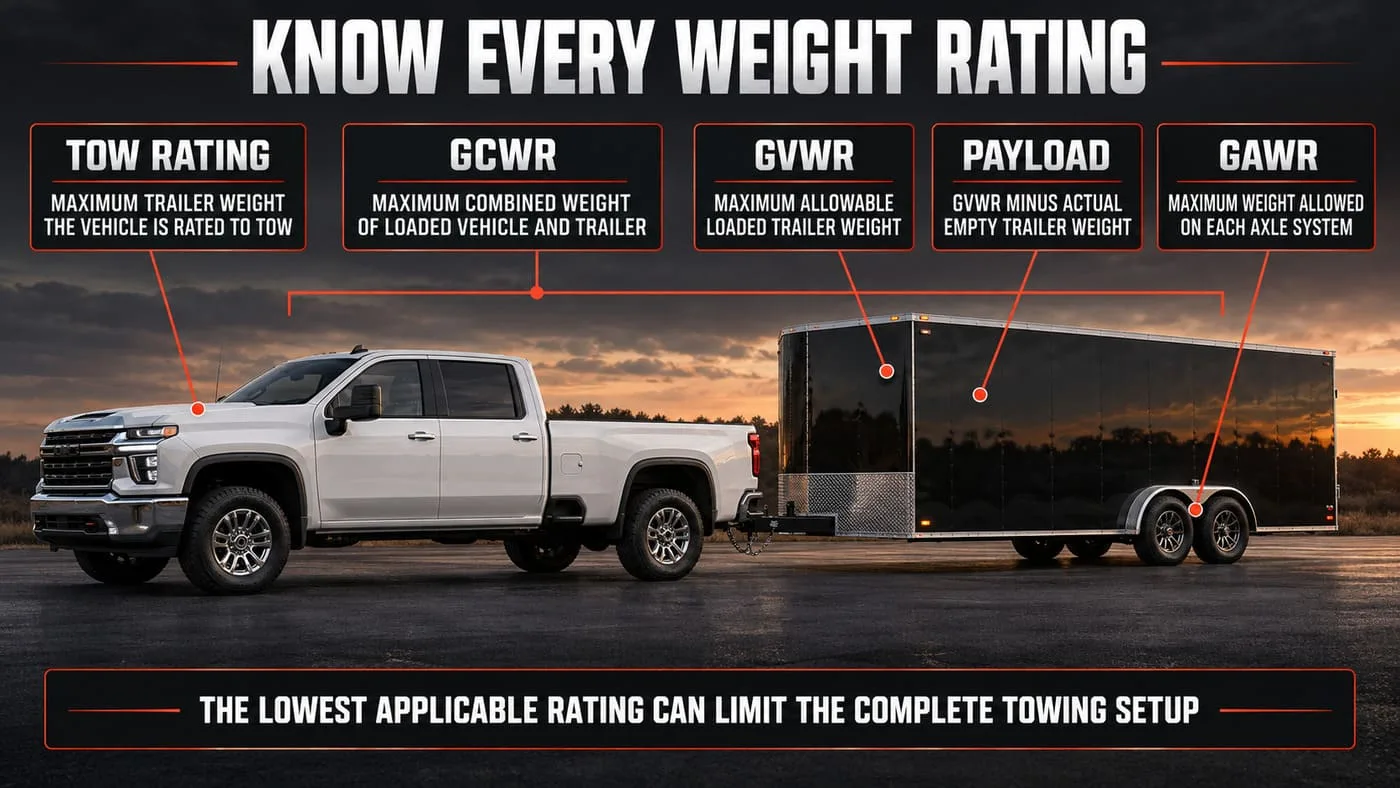
GVWR: Gross Vehicle Weight Rating
The trailer’s GVWR is the maximum allowable total weight of the loaded trailer.
This includes:
- ✓Empty trailer
- ✓Cargo
- ✓Spare tires
- ✓Batteries
- ✓Generator
- ✓Cabinets
- ✓Air conditioning
- ✓Water tanks
- ✓Tools
- ✓Fuel
- ✓Accessories
- ✓All permanent upgrades
The trailer should never be loaded beyond its listed GVWR.
GAWR: Gross Axle Weight Rating
GAWR is the maximum weight that may be carried by an individual axle system as specified for that application.
Combined axle capacity does not automatically equal trailer GVWR. Frame design, coupler rating, tires, wheels, brakes and manufacturer certification can affect the trailer’s final rating.
Payload Capacity
Payload is the amount of cargo and added equipment the trailer can carry without exceeding its GVWR.
GVWR − Actual Empty Trailer Weight = Available Payload
The actual completed trailer weight is more useful than a general model estimate. Options such as cabinets, finished interiors, generators, winches and air conditioning reduce the remaining capacity available for cargo.
Tow Rating
The tow rating is the maximum trailer weight the vehicle manufacturer permits under a particular configuration.
Tow rating can change based on:
- ✓Engine
- ✓Transmission
- ✓Axle ratio
- ✓Cab configuration
- ✓Bed length
- ✓Two-wheel or four-wheel drive
- ✓Towing package
- ✓Cooling equipment
- ✓Installed hitch
- ✓Number of passengers
- ✓Cargo carried in the vehicle
Use the tow vehicle’s manufacturer-provided information for its exact year, model and configuration.
Vehicle Payload Rating
Tow-vehicle payload includes the people, cargo and equipment carried by the vehicle, along with the downward tongue weight applied by the trailer.
A vehicle may be within its tow rating but exceed its payload rating after passengers, tools, accessories and trailer tongue weight are added.
GCWR: Gross Combined Weight Rating
GCWR is the maximum allowable combined weight of the loaded tow vehicle and loaded trailer.
The combined weight includes:
- ✓Tow vehicle
- ✓Driver
- ✓Passengers
- ✓Fuel
- ✓Cargo inside the vehicle
- ✓Trailer
- ✓Cargo inside the trailer
- ✓Installed equipment and accessories
DO NOT RELY ON TOW RATING ALONE—CHECK EVERY APPLICABLE LIMIT
Related guide: Trailer GVWR Guide
Related guide: Enclosed Trailer Weight Chart
Know the Trailer’s Actual Loaded Weight
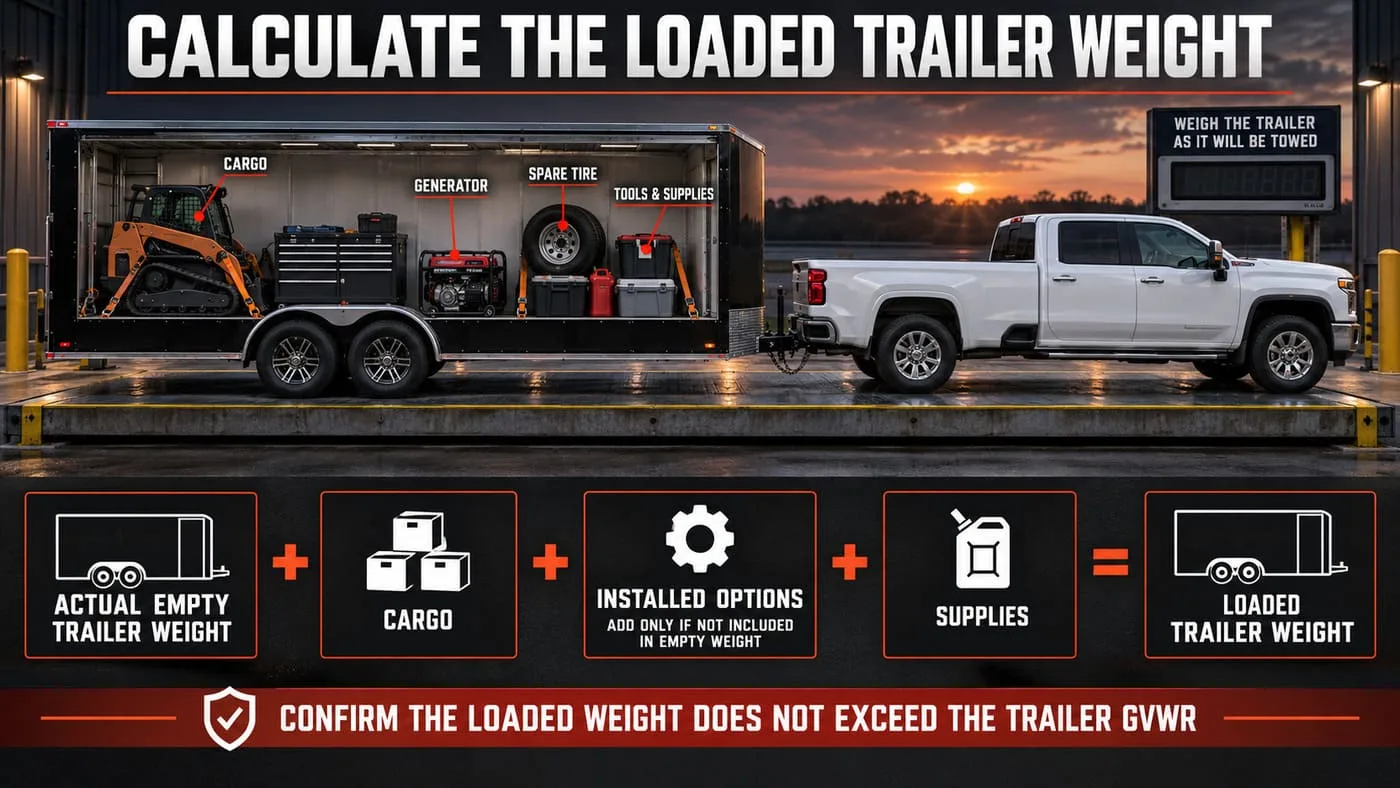
The most dependable way to determine loaded trailer weight is to weigh the completed and loaded trailer on a suitable scale.
Do not rely only on the trailer’s empty-weight estimate. Published empty weights may not include every custom option, accessory or item added after manufacturing.
Before weighing, load the trailer as it would normally be used. Include:
- ✓Equipment
- ✓Tools
- ✓Vehicles
- ✓Fuel
- ✓Water
- ✓Batteries
- ✓Generator
- ✓Spare tire
- ✓Cabinets
- ✓Supplies
- ✓Personal cargo
Knowing the actual loaded weight helps determine whether the trailer remains within its GVWR and whether the tow vehicle, hitch and related components are appropriately rated.
Understand Tongue Weight
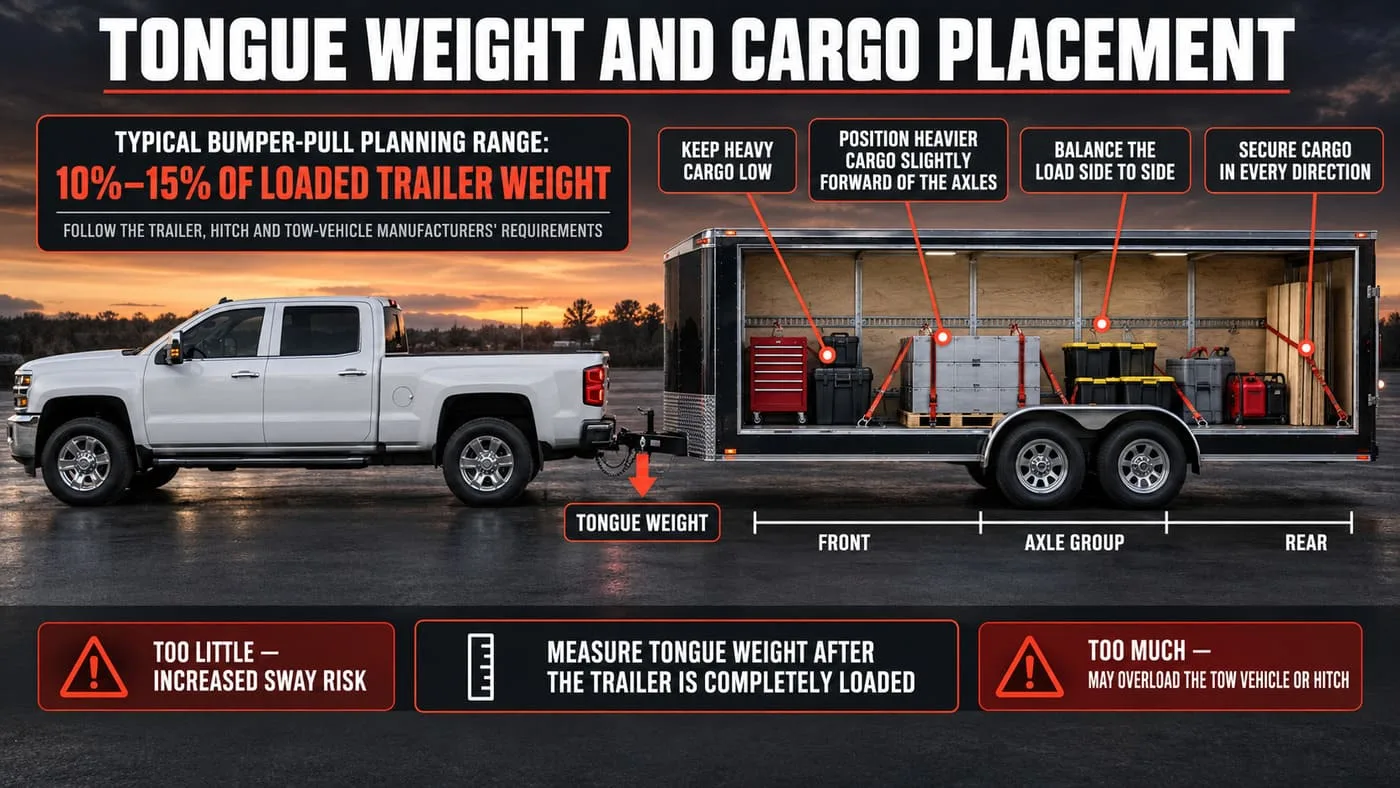
Tongue weight is the amount of the trailer’s loaded weight pressing downward on the hitch.
Too little tongue weight can make the trailer more likely to sway. Too much tongue weight can overload the tow vehicle’s rear axle, receiver, suspension or payload capacity.
For many conventional bumper-pull trailers, tongue weight often falls within approximately 10% to 15% of the loaded trailer weight. This is a planning range—not a substitute for the trailer and tow-vehicle manufacturers’ requirements.
For example:
| Loaded trailer weight | 7,000 pounds |
| Approximate 10% tongue weight | 700 pounds |
| Approximate 15% tongue weight | 1,050 pounds |
The tow vehicle must have enough available payload capacity for the tongue weight plus passengers, cargo and vehicle accessories.
Tongue weight changes when cargo is moved. Placing heavy cargo farther forward generally increases tongue weight. Moving it rearward generally reduces tongue weight and may increase the potential for sway.
Tongue weight should be measured after the trailer is completely loaded.
Related guide: Tongue Weight & Proper Loading Guide
Load the Trailer for Stability
Keep Heavy Cargo Low
Heavy equipment should generally be carried as low as practical. A high center of gravity can increase body roll and reduce stability during turns or emergency maneuvers.
Control Front-to-Rear Placement
Do not automatically push heavy cargo against the rear of the trailer. Excessive rear loading can remove weight from the tongue and contribute to sway.
Heavy cargo should be positioned according to the trailer’s layout, axle placement and measured tongue weight.
Balance the Load Side to Side
Significantly loading one side more heavily than the other can affect tire loading, suspension movement and trailer handling.
Secure Every Item
Cargo must be restrained against:
- ✓Forward movement
- ✓Rearward movement
- ✓Side-to-side movement
- ✓Vertical movement
Use tie-down equipment that is properly rated for the cargo. Inspect D-rings, E-Track, straps, chains and attachment points before towing.
A heavy machine or vehicle can shift during hard braking even if it does not move during normal acceleration.
Recheck After Traveling
Stop after the first portion of the trip and recheck the cargo restraints. Straps can settle or loosen as the trailer moves.
A LOAD THAT FITS INSIDE THE TRAILER IS NOT AUTOMATICALLY A SAFE LOAD
Match Every Hitch Component to the Load
The towing system contains several separately rated parts:
- ✓Receiver hitch
- ✓Ball mount
- ✓Hitch ball
- ✓Coupler
- ✓Hitch pin
- ✓Weight-distribution system when used
The capacity of the towing connection is limited by its lowest-rated component.
Confirm the Hitch-Ball Size
The hitch ball must match the size marked on the trailer coupler. A mismatched ball and coupler can appear connected without being safely secured.
Check the Ball Mount
The ball mount must have adequate trailer-weight and tongue-weight ratings. It must also position the trailer at an appropriate towing height.
Tow the Trailer Level
A bumper-pull trailer should generally sit approximately level when loaded and connected.
A trailer that is noticeably nose-high or nose-low may distribute weight incorrectly between the axles and affect handling, braking and tire loading.
An appropriate rise or drop ball mount may be required to match the tow vehicle’s receiver height to the trailer’s coupler height.
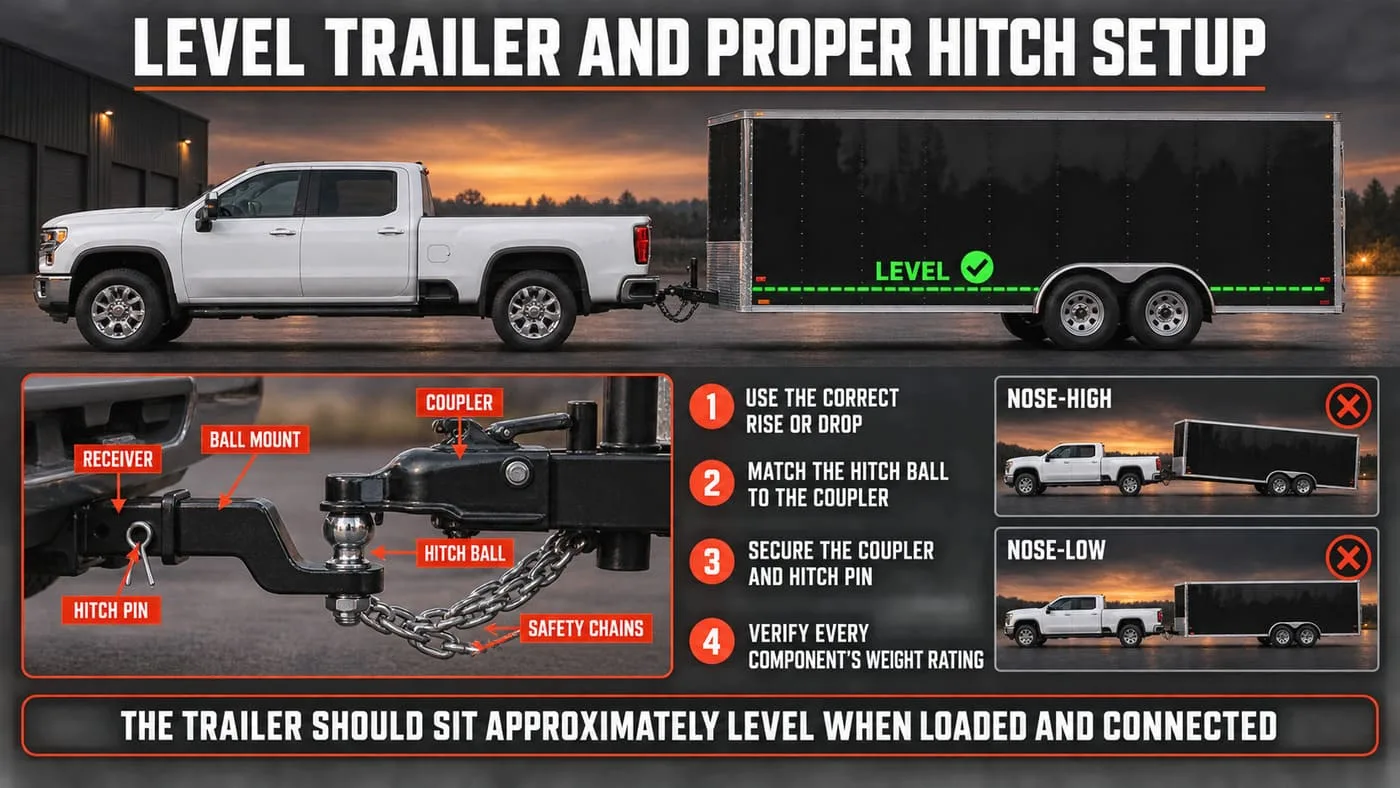
Confirm the Coupler Is Locked
Lower the coupler completely onto the ball, close the latch and secure it with the correct pin or lock.
Do not assume the trailer is connected merely because the coupler is resting on the ball. Raise the tongue jack slightly after coupling to confirm the connection is secure.
Related guide: Trailer Hitch & Coupler Guide
Connect Safety Chains Correctly
Safety chains provide a secondary connection if the trailer separates from the hitch ball.
Before every trip:
- ✓Attach both chains to approved receiver locations
- ✓Do not attach chains only to the removable ball mount
- ✓Leave enough length for turning
- ✓Prevent chains from dragging
- ✓Inspect hooks and chain links for damage
- ✓Confirm the chains cannot bind during sharp turns
Where appropriate for the setup, crossing the chains beneath the coupler may help support the trailer tongue if the primary connection fails.
Safety chains do not replace a properly connected and locked coupler.
Check the Breakaway System
The breakaway system is designed to activate the trailer brakes if the trailer separates from the tow vehicle.
A typical system includes:
- ✓Breakaway switch
- ✓Pull cable
- ✓Breakaway battery
- ✓Battery box
- ✓Wiring to the trailer brakes
Attach the breakaway cable to a secure point on the tow vehicle that is independent of the safety chains and removable ball mount.
The cable must have enough length for normal turns without dragging or activating accidentally.
The breakaway battery should be charged and tested periodically. A disconnected, damaged or discharged breakaway battery may leave the emergency system unable to operate correctly.
IMPORTANT: Do not use the breakaway switch as a parking brake.
Trailer Brakes and Brake Controllers
Electric trailer brakes are controlled by a compatible brake controller installed in or integrated into the tow vehicle.
The controller should be adjusted so that the trailer contributes appropriate braking without locking its wheels or pushing the tow vehicle.
Test the Brakes Before Entering Traffic
At low speed in a safe location:
- Apply the trailer brakes manually using the controller.
- Confirm that the trailer brakes respond.
- Check for pulling, grabbing or weak braking.
- Adjust the controller according to its instructions and the load.
- Recheck the setting whenever trailer weight changes substantially.
Too little trailer braking can place excessive demand on the tow vehicle. Too much trailer braking can lock the trailer wheels and reduce control.
Brake-controller settings may need to change when:
- ✓Cargo is added or removed
- ✓Road conditions change
- ✓A different trailer is connected
- ✓Brake components are serviced
- ✓Trailer weight changes
Trailer brakes should be inspected and maintained according to the axle, brake and trailer manufacturers’ recommendations.
Related guide: Trailer Brake Guide
Weight-Distribution Hitches
A weight-distribution hitch may help distribute tongue weight across the towing combination and improve vehicle attitude when it is approved and properly configured.
It does not:
- ✗Increase the trailer’s GVWR
- ✗Increase tire or axle ratings
- ✗Automatically increase vehicle payload
- ✗Correct an overloaded trailer
- ✗Replace proper cargo placement
- ✗Eliminate the need for correct tongue weight
Not every trailer or tow vehicle is compatible with every weight-distribution system. Confirm compatibility and setup requirements with the vehicle, hitch and trailer manufacturers.
A weight-distribution hitch and a sway-control device perform related but different functions. Some systems combine both features.
What Causes Enclosed Trailer Sway?
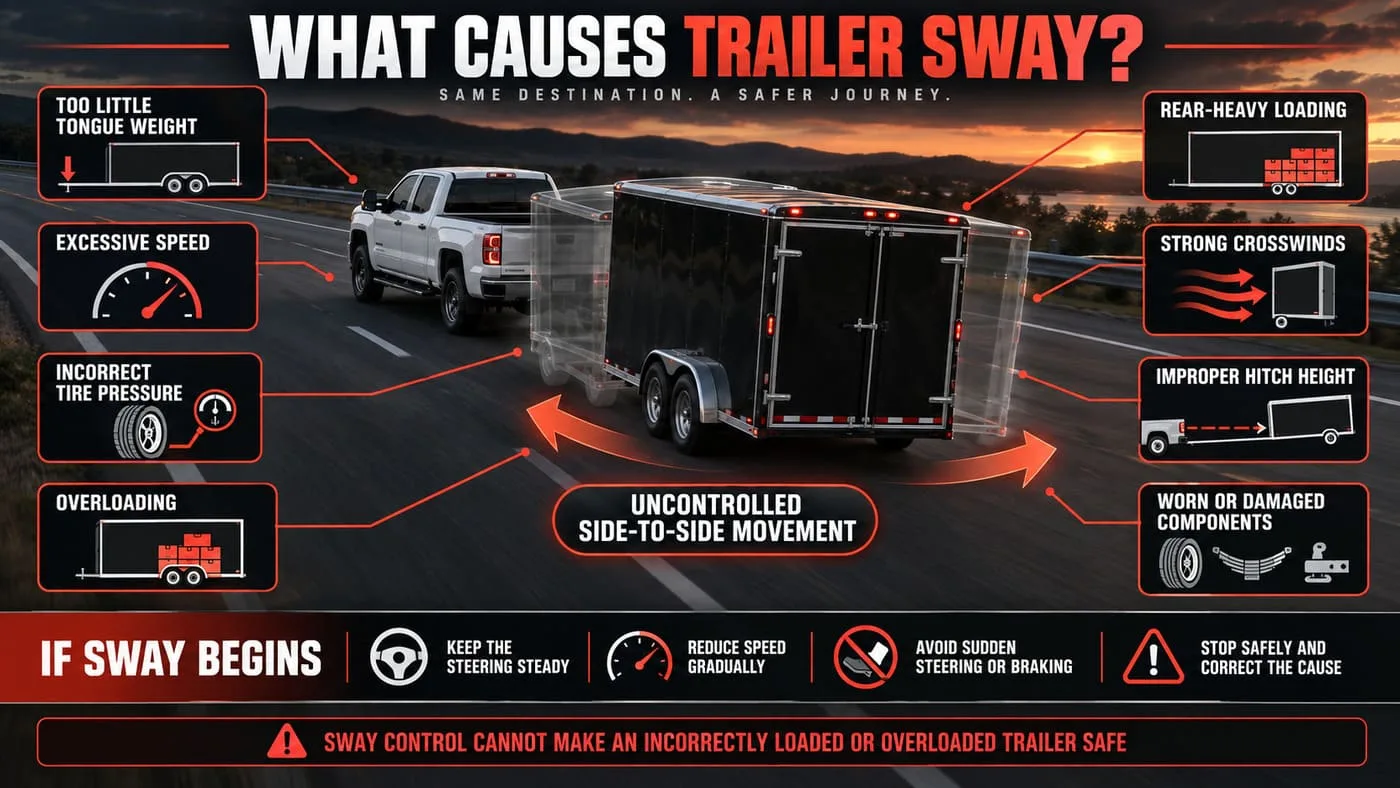
Trailer sway is an uncontrolled side-to-side movement that can become dangerous quickly.
Possible contributing factors include:
- ✗Insufficient tongue weight
- ✗Excessive rear loading
- ✗Excessive speed
- ✗Strong crosswinds
- ✗Passing large trucks
- ✗Sudden steering
- ✗Improper tire pressure
- ✗Worn or damaged suspension
- ✗Mismatched tires
- ✗Trailer or tow-vehicle overloading
- ✗Incorrect hitch height
- ✗Inadequate tow vehicle
- ✗Unsecured cargo shifting during travel
Enclosed trailers have large side surfaces that can be affected by wind. The driver should reduce speed and allow additional space when conditions become unfavorable.
What to Do if Trailer Sway Begins
Remain calm and avoid sudden steering.
Depending on the towing setup and conditions:
- ✓Gradually reduce speed
- ✓Keep the steering wheel steady
- ✓Avoid abrupt braking
- ✓Avoid accelerating
- ✓Apply the trailer brakes manually with the brake controller when appropriate
- ✓Pull over safely and inspect the trailer
Do not continue at the same speed without identifying the likely cause. Check cargo placement, tongue weight, tires, hitch height and all connections.
A sway-control device cannot make an incorrectly loaded or overloaded trailer safe.
Trailer Tires and Wheels
Trailer tires support the load and are critical to towing safety.
Before traveling, inspect:
- ✓Cold tire pressure
- ✓Tire load rating
- ✓Cracks
- ✓Bulges
- ✓Cuts
- ✓Exposed cords
- ✓Irregular wear
- ✓Embedded objects
- ✓Valve stems
- ✓Wheel damage
- ✓Lug-nut condition
- ✓Spare-tire condition
Inflate tires according to the trailer or tire manufacturer’s instructions while the tires are cold.
Do not use the pressure molded into the tire sidewall as an automatic recommendation without checking the trailer manufacturer’s requirements. Do not exceed the tire or wheel limitations.
All tires must provide enough combined load capacity for the trailer application.
Trailer tires can deteriorate from age and exposure even when tread remains. Inspect trailers that sit outside or remain unused for extended periods carefully before towing.
Related guide: Enclosed Trailer Tire Guide
Lug Nuts, Hubs and Bearings
Loose lug nuts can damage wheels and studs or lead to wheel separation.
Check and tighten lug nuts using the correct torque and tightening pattern specified by the trailer, axle or wheel manufacturer.
Newly installed wheels may require additional torque checks after initial travel.
Also watch for signs of hub or bearing trouble:
- ✓Unusual heat
- ✓Grease leakage
- ✓Grinding noise
- ✓Wheel movement
- ✓Burning smell
- ✓Uneven wheel rotation
IMPORTANT: Stop towing if a hub becomes excessively hot, a wheel wobbles or a bearing problem is suspected.
Related guide: Trailer Axle Guide
Related guide: Enclosed Trailer Maintenance Guide
Mirrors, Visibility and Turning Clearance
The driver must be able to see along both sides of the trailer and monitor surrounding traffic.
Towing mirrors may be necessary when the trailer is wider than the tow vehicle.
Before towing, verify:
- ✓Adequate rearward visibility
- ✓Mirror adjustment
- ✓Turning clearance
- ✓Trailer-to-vehicle clearance
- ✓Jack clearance
- ✓Tailgate clearance
- ✓Safety-chain length
- ✓Electrical-cord length
- ✓Breakaway-cable length
Practice wide turns in a safe area. Trailer wheels track inside the path of the tow vehicle, so additional clearance is required around curbs, signs, fuel pumps and other vehicles.
Allow More Time for Braking
A loaded trailer increases stopping distance.
Maintain additional following distance and begin slowing earlier than you would without a trailer.
Stopping distance may be affected by:
- ✓Trailer weight
- ✓Vehicle weight
- ✓Brake condition
- ✓Brake-controller adjustment
- ✓Tire traction
- ✓Road surface
- ✓Weather
- ✓Speed
- ✓Road grade
Avoid abrupt steering or braking whenever possible. Smooth acceleration, gradual braking and deliberate lane changes help keep the trailer stable.
Reduce speed before entering a curve. Braking heavily after entering the curve can reduce stability.
Hills and Long Grades
Long grades increase demand on the engine, transmission and brakes.
Before traveling through steep terrain:
- ✓Confirm the tow vehicle is properly equipped
- ✓Check engine and transmission fluids
- ✓Verify trailer brakes
- ✓Inspect tires
- ✓Understand the vehicle’s towing or transmission modes
- ✓Plan fuel and stopping locations
- ✓Review the route for restrictions
Use an appropriate gear and follow the tow-vehicle manufacturer’s guidance.
Do not depend only on the service brakes to control speed on long downhill grades. Excessive braking can generate heat and reduce braking effectiveness.
IMPORTANT: Stop safely if you notice brake fade, smoke, burning odor, warning lights or abnormal handling.
Before You Tow: Pre-Trip Checklist
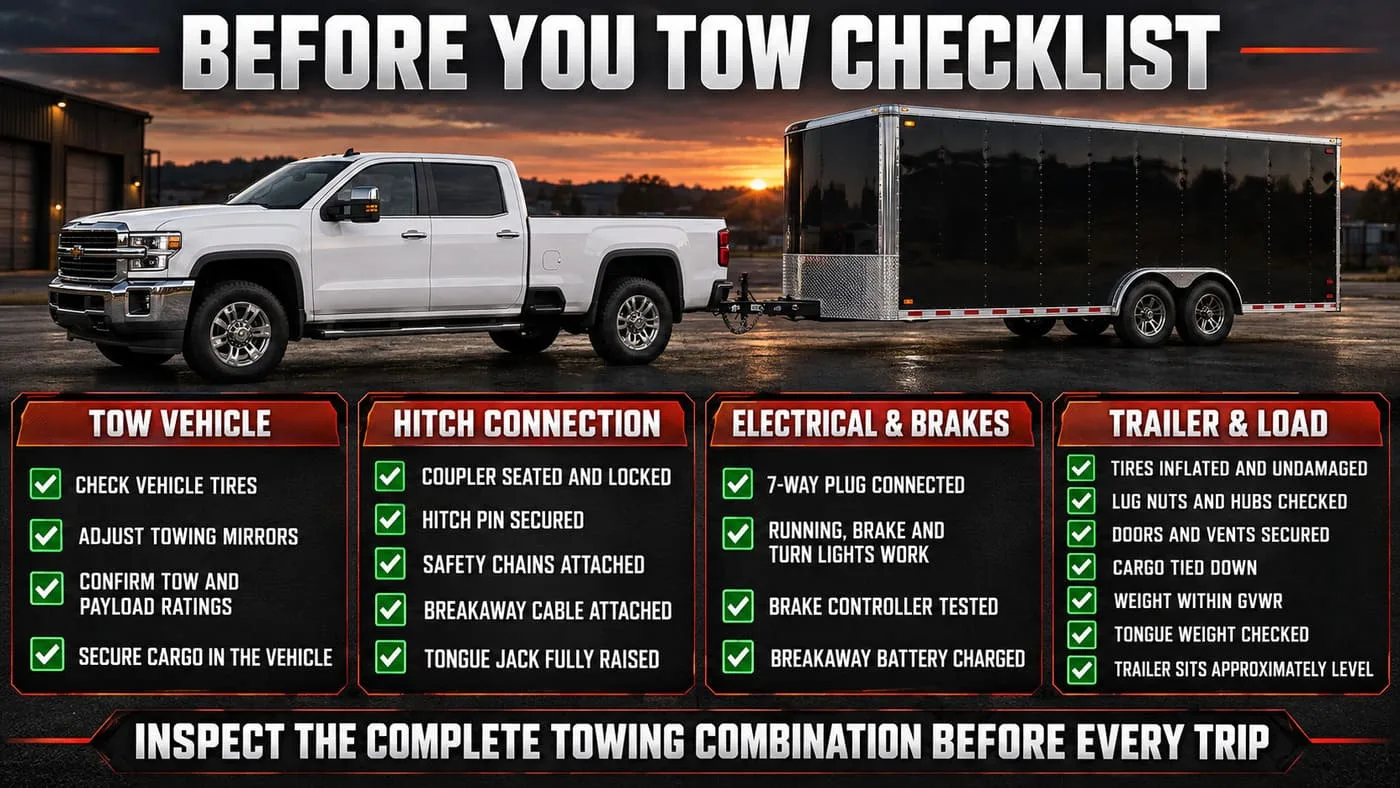
Before every trip, confirm the tow vehicle, hitch connection, electrical and brake systems, and trailer and load are ready. The checklist above summarizes the key checks covered throughout this guide—tow vehicle readiness, a secure hitch connection, working lights and brakes, and a properly loaded and secured trailer.
Stop Towing Immediately If You Notice
Find a safe location and stop if you experience:
- ✗Severe trailer sway
- ✗Loss of trailer braking
- ✗Smoke or burning odor
- ✗Excessively hot hub
- ✗Wheel wobble
- ✗Damaged or flat tire
- ✗Exposed tire cords
- ✗Broken spring
- ✗Coupler movement
- ✗Loose hitch components
- ✗Dragging safety chains
- ✗Shifting cargo
- ✗Cracked frame or weld
- ✗Unusual vibration or noise
- ✗Trailer lights failing at night
- ✗Trailer leaning noticeably
Continuing to tow after detecting a serious mechanical or connection problem can increase the damage and risk.
Match the Trailer to Your Load and Tow Vehicle
Choosing the correct enclosed trailer begins with the cargo—but it must also include the tow vehicle and complete towing setup.
Before ordering, determine:
- ✓Cargo dimensions
- ✓Total cargo weight
- ✓Required trailer payload
- ✓Expected loaded trailer weight
- ✓Desired trailer size
- ✓Axle and brake package
- ✓Tongue weight
- ✓Tow-vehicle ratings
- ✓Hitch and coupler requirements
- ✓Tie-down locations
- ✓Weight of installed upgrades
Southern Trailer Depot can help you compare enclosed trailer sizes, axle packages, GVWR configurations, doors, tie-down options and custom features.
From standard inventory to custom builds, we’ll help you plan the next step.
Better Trailers Since 2007
Southern Trailer Depot—We’ve Got Your Trailer!
Important Safety Notice
Trailer configurations, hitch requirements, ratings and towing limits vary.
Always follow the instructions and ratings provided by the tow-vehicle, trailer, hitch, coupler, axle, brake and component manufacturers. Comply with all applicable federal, state and local towing requirements.
Do not tow if any component is damaged, improperly connected, incompatible or inadequately rated.
Frequently Asked Questions
How large of a vehicle do I need to tow an enclosed trailer?
The correct vehicle depends on the trailer’s actual loaded weight, tongue weight, vehicle tow rating, payload capacity, axle ratings, GCWR and hitch rating. Check the exact vehicle configuration rather than relying on a general model advertisement.
How much tongue weight should an enclosed trailer have?
Many conventional bumper-pull trailers operate within a tongue-weight range of approximately 10% to 15% of loaded trailer weight. Follow the requirements for the specific trailer, tow vehicle and hitch.
Why does my enclosed trailer sway?
Common causes include insufficient tongue weight, rear-heavy loading, excessive speed, wind, incorrect tire pressure, worn components or an inadequate towing setup.
Should an enclosed trailer sit level while towing?
A bumper-pull trailer should generally sit approximately level when loaded and connected. Incorrect hitch height can affect axle loading, stability and tire wear.
Do I need a brake controller?
Trailers equipped with electric brakes require a compatible method of controlling those brakes. Requirements may also depend on trailer weight and state law.
Can I tow up to the truck’s advertised maximum?
The advertised maximum applies only under specific conditions. Payload, passengers, cargo, vehicle configuration, hitch ratings, tongue weight and GCWR can lower the practical limit.
Does a weight-distribution hitch increase towing capacity?
A weight-distribution hitch does not increase the trailer’s GVWR or the ratings of tires, axles and other components. Follow the ratings and instructions for the tow vehicle and hitch.
How often should I stop and inspect the trailer?
Inspect the complete setup before departure. Stop after the initial portion of the trip to recheck cargo restraints, tires, hubs and hitch connections. Continue making periodic inspections during longer trips.