
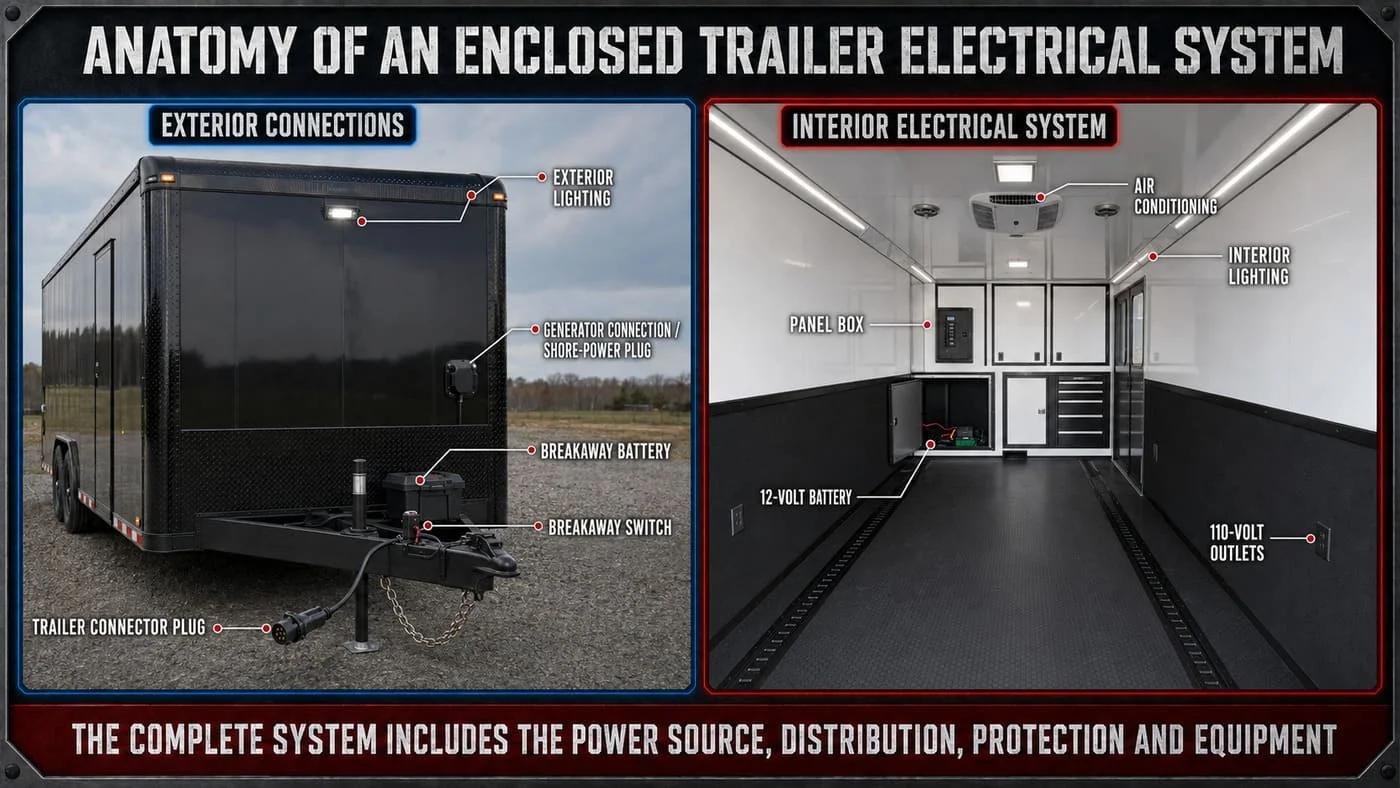
An enclosed trailer electrical system can be as simple as basic running lights or as complete as a system supporting interior lighting, electrical outlets, batteries, air conditioning, tools and other equipment.
The correct system depends on how the trailer will be used, where its power will come from and how much electricity the installed equipment requires.
A contractor trailer may need lighting, outlets and battery power for tools. A race trailer may require shore power, air conditioning, cabinets and multiple interior circuits. A mobile-service trailer may need dependable off-grid power and organized equipment connections.
These systems should be planned together before construction whenever possible.
This guide explains the difference between 12-volt and 110-volt electrical systems, how shore power and generators fit into the system and what buyers should consider before ordering an electrically equipped enclosed trailer.
IMPORTANT NOTE: Electrical options and components vary by trailer, manufacturer and build specifications. Always confirm the equipment included with the specific trailer and follow the instructions provided by the trailer, electrical-component and appliance manufacturers.
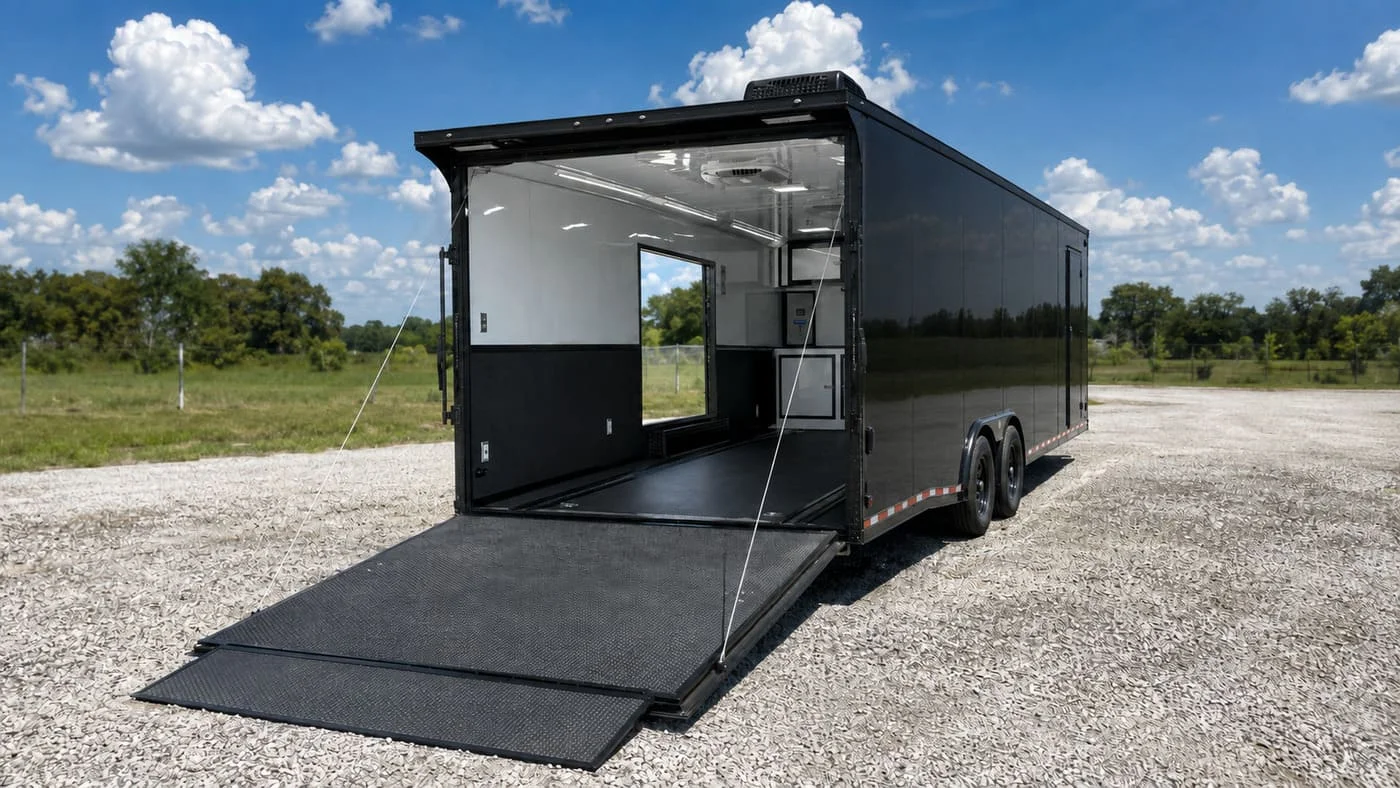
Why Electrical Planning Matters
Electrical equipment affects more than convenience. It can influence the trailer’s construction, interior layout, roof bracing, available payload and future service access.
Electrical planning may affect:
- ✓Wall and ceiling construction
- ✓Interior panel installation
- ✓Wiring routes
- ✓Outlet locations
- ✓Lighting placement
- ✓Battery location
- ✓Breaker and fuse-panel placement
- ✓Shore-power connection
- ✓Generator compartment design
- ✓Air-conditioning installation
- ✓Ventilation requirements
- ✓Equipment weight
- ✓Future repairs and upgrades
Adding electrical equipment after the walls and ceiling are finished may require removing panels, drilling new penetrations or routing wiring through areas that were not originally designed for it.
Planning the system before the trailer is built usually provides cleaner wiring routes and better coordination between the electrical equipment, insulation, interior finish and structural bracing.
Understand the Two Main Electrical Systems
Many finished enclosed trailers use a combination of 12-volt direct-current power and 110- or 120-volt alternating-current power.
Although the trailer industry frequently calls it a 110-volt package, standard shore-power equipment is generally based on nominal 120-volt AC service.
12-Volt DC System
A 12-volt system can operate selected equipment from a battery without requiring the trailer to remain connected to shore power.
Common 12-volt equipment may include:
- ✓Interior LED lighting
- ✓Exterior loading lights
- ✓Breakaway battery
- ✓Powered roof vents
- ✓Electric tongue jack
- ✓Winch
- ✓Water pump
- ✓USB charging connections
- ✓Stereo equipment
- ✓Selected accessories
A 12-volt system normally includes a battery, wiring, circuit protection and switches or controls.
The size of the battery and charging system should match the equipment, expected operating time and frequency of use.
110-Volt Electrical Package
A 110-volt electrical package allows the trailer to operate compatible AC equipment when connected to shore power or a properly sized generator.
Common 110-volt equipment may include:
- ✓Electrical outlets
- ✓Interior lighting
- ✓Air conditioning
- ✓Battery converter or charger
- ✓Refrigerators
- ✓Microwaves
- ✓Compressors
- ✓Power tools
- ✓Concession equipment
- ✓Mobile-service equipment
A complete package may include a shore-power inlet, breaker panel, branch circuits, outlets and wiring for specific equipment.
The exact equipment and available power depend on the individual trailer and its electrical specifications.
12-Volt vs. 110-Volt Trailer Power
| Feature | 12-Volt DC System | 110-Volt AC System |
|---|---|---|
| Typical power source | Battery | Shore power or generator |
| Common equipment | LED lights, vents, jack and accessories | Outlets, air conditioning, tools and appliances |
| Off-grid operation | Possible within battery capacity | Requires generator, inverter system or another AC source |
| Circuit protection | Fuses or DC breakers | AC circuit breakers |
| Battery charging | Requires a compatible charging source | A converter/charger may recharge a compatible battery |
| Best use | Lighting and selected mobile accessories | Higher-demand equipment and standard outlets |
| Main limitation | Battery capacity and charging | Available amperage and power-source capacity |
Many customized trailers use both systems.
For example, the interior lights may operate on 12-volt battery power, while the outlets and air conditioner operate through the 110-volt package when the trailer is connected to shore power.
Note: a dedicated 12-volt vs. 110-volt comparison graphic was requested for this section but was not available among the supplied assets, so this section uses the table above instead.
How Power Moves Through the Trailer
A trailer’s electrical path depends on the equipment installed, but a combination system may follow this general sequence:
SHORE POWER OR GENERATOR
↓
POWER INLET
↓
BREAKER PANEL
↓
110-VOLT OUTLETS AND EQUIPMENT · CONVERTER OR BATTERY CHARGER
↓
12-VOLT BATTERY AND FUSE PANEL
↓
12-VOLT LIGHTS AND ACCESSORIES
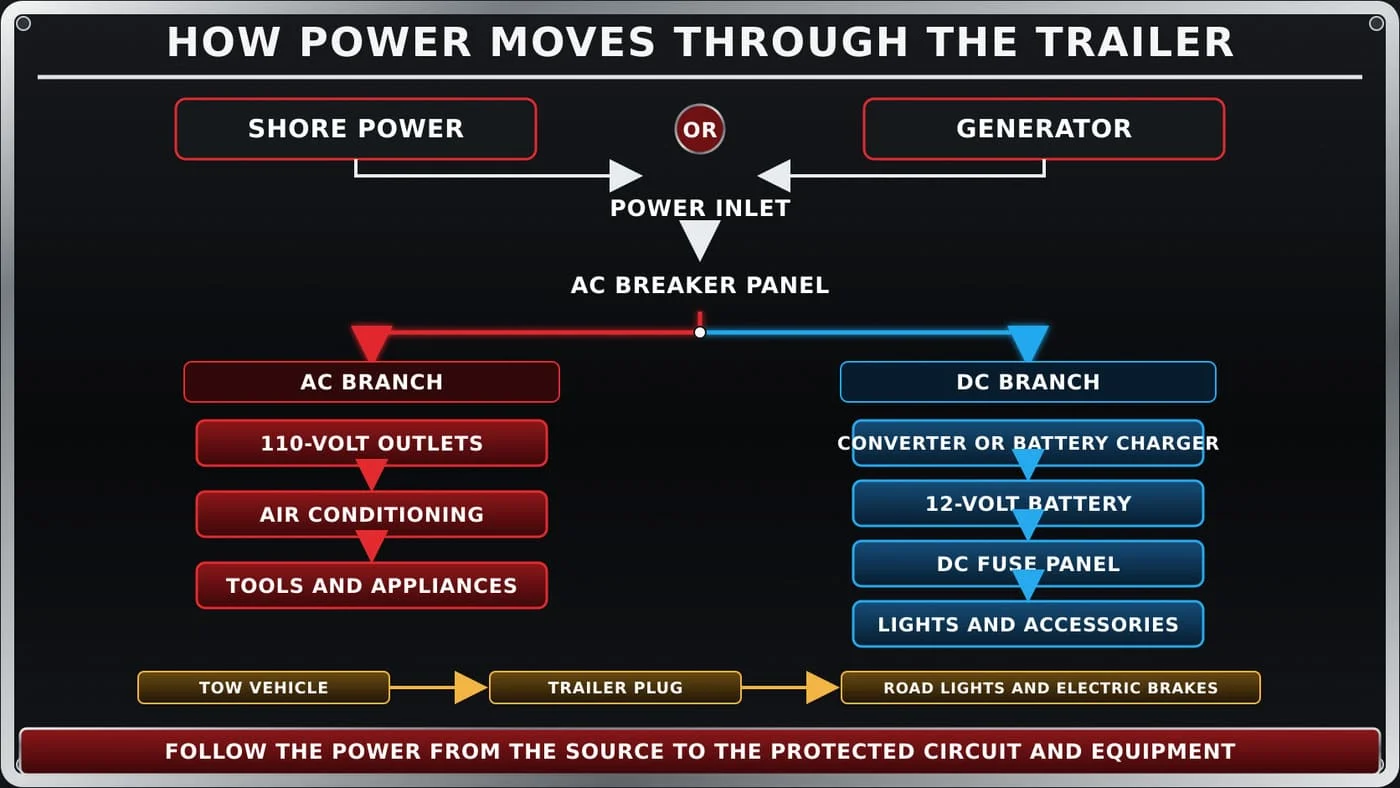
Not every trailer includes every component shown in this sequence. A basic cargo trailer may only have road lights powered through the tow vehicle. A finished trailer may have separate AC and DC systems with shore power, a battery and a converter or charger.
Converter vs. Inverter
A converter and an inverter perform different jobs.
A converter changes AC power into DC power. Depending on the equipment, it may supply 12-volt accessories and charge a compatible battery while the trailer is connected to shore power.
An inverter changes battery-supplied DC power into AC power for compatible equipment.
An inverter does not create electricity. It draws energy from the battery, and the available operating time depends on the battery capacity, inverter capacity, equipment load and system efficiency.
IMPORTANT: Do not assume a trailer includes an inverter simply because it has a battery or electrical outlets.
Shore Power, Generator Power and Battery Power
The power source should match how and where the trailer will be used.
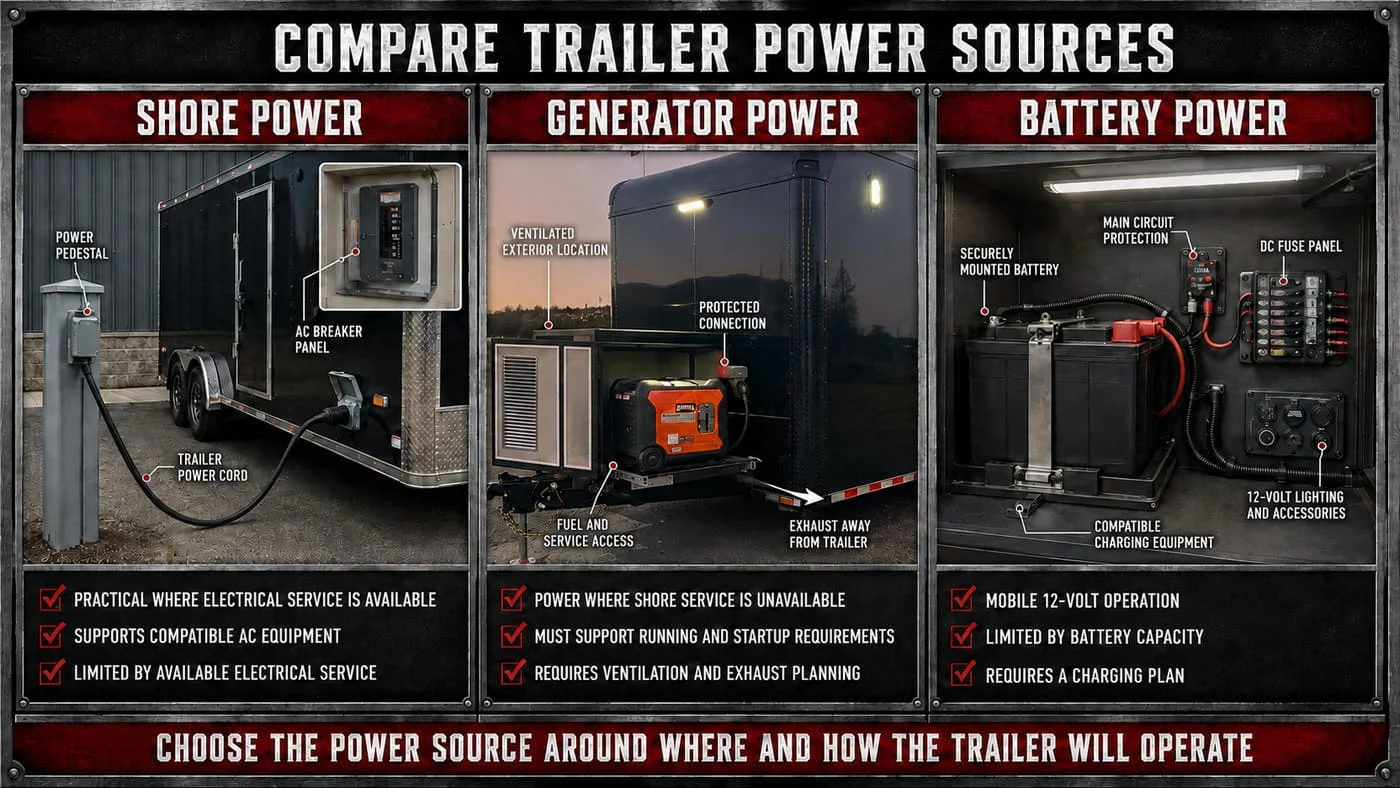
Shore Power
Shore power is supplied by connecting the trailer to an external electrical source.
It can be a practical choice when the trailer will regularly operate at:
- ✓A home or shop
- ✓A racetrack with electrical service
- ✓A campground
- ✓A commercial property
- ✓A jobsite with approved power access
- ✓An event location with available service
The trailer’s inlet, cord, adapters and available electrical service must be compatible with the completed system.
Generator Power
A generator can provide AC power where shore power is unavailable.
Generator planning should consider:
- ✓Total operating load
- ✓Equipment startup requirements
- ✓Air-conditioning requirements
- ✓Generator output
- ✓Fuel storage
- ✓Exhaust direction
- ✓Ventilation
- ✓Noise
- ✓Compartment construction
- ✓Service access
- ✓Generator weight
An air conditioner or other motor-driven equipment may require more power during startup than during normal operation. Generator selection should follow the requirements of the installed equipment rather than relying only on its advertised running load.
Battery Power
A battery can operate selected 12-volt equipment when shore power is unavailable.
Battery planning should include:
- ✓Equipment demand
- ✓Expected operating time
- ✓Battery type
- ✓Battery capacity
- ✓Charging method
- ✓Charger compatibility
- ✓Cable sizing
- ✓Circuit protection
- ✓Battery mounting
- ✓Ventilation requirements
- ✓Service access
Battery chemistry and the charging equipment must be compatible. Do not assume that one charger is appropriate for every battery type.
The Breakaway Battery Is a Safety Component
Trailers equipped with electric brakes commonly use a breakaway system designed to apply the trailer brakes if the trailer separates from the tow vehicle.
The breakaway system may include:
- ✓Breakaway switch
- ✓Pull cable
- ✓Battery
- ✓Battery box
- ✓Wiring
- ✓Charging connection
The breakaway battery should not automatically be treated as the main power source for the trailer’s interior accessories.
A trailer may have one battery for the breakaway system and a separate battery system for lights, a winch or other equipment.
Before towing:
- ✓Confirm the breakaway battery is charged
- ✓Inspect the switch and wiring
- ✓Check the pull cable
- ✓Attach the cable correctly
- ✓Follow the axle and breakaway-system manufacturer’s testing instructions
CALLOUT: Do not attach the breakaway cable in a way that prevents it from operating if the trailer separates from the tow vehicle.
Plan the Complete Electrical Load
Electrical equipment should be selected as one complete system.
Start by listing every item expected to operate inside or from the trailer.
Possible equipment includes:
- ✓Air conditioner
- ✓Interior lights
- ✓Exterior lights
- ✓Electrical outlets
- ✓Battery charger
- ✓Refrigerator
- ✓Microwave
- ✓Compressor
- ✓Power tools
- ✓Winch
- ✓Water pump
- ✓Stereo
- ✓Television or monitor
- ✓Concession equipment
- ✓Mobile-service equipment
- ✓Computers and communication equipment
For each item, confirm:
- ✓Operating voltage
- ✓Running power requirement
- ✓Startup requirement
- ✓Circuit requirements
- ✓Expected operating time
- ✓Whether other equipment will operate at the same time
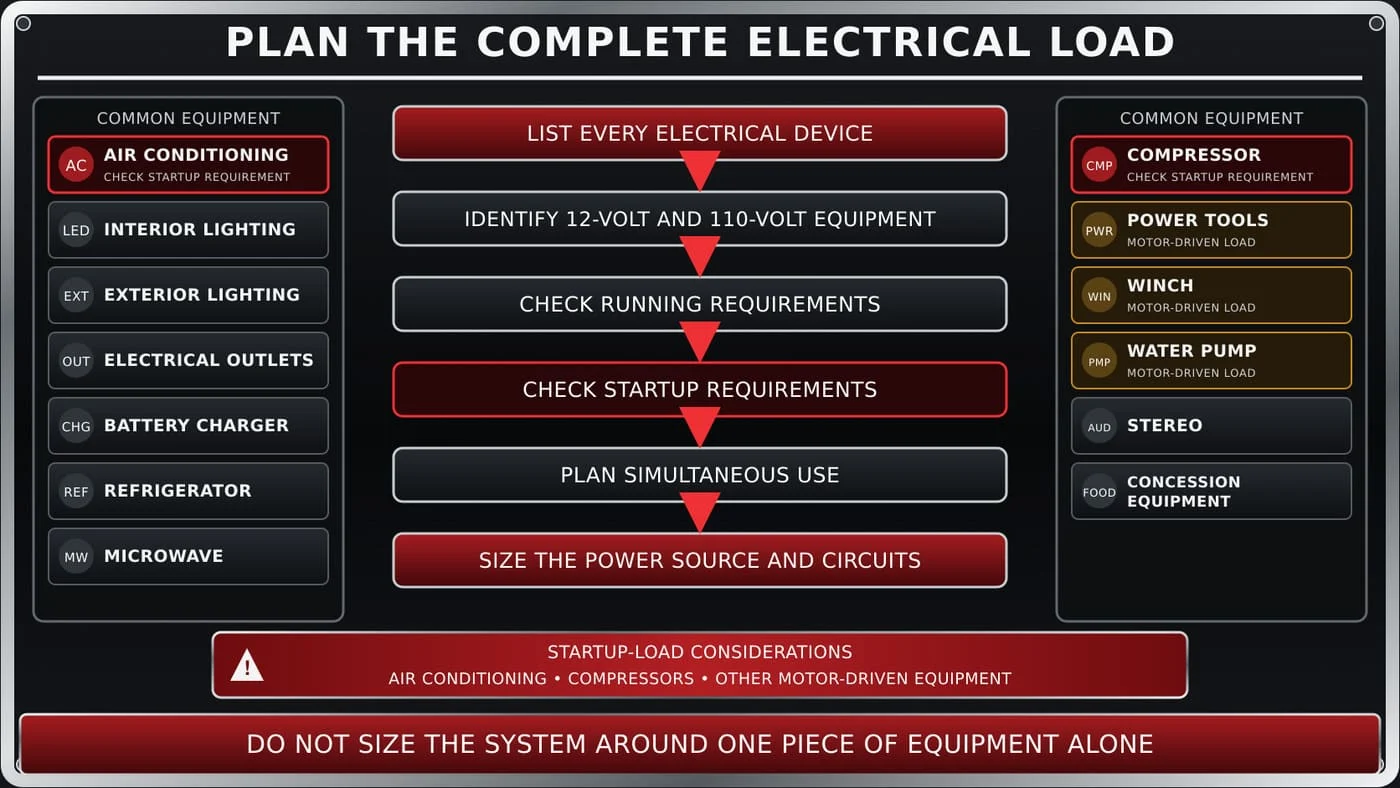
Adding the wattage printed on several product labels may not provide the complete answer because startup loads and simultaneous equipment use can affect the required system capacity.
The installed equipment manufacturer’s specifications should be used when planning the electrical service, circuits, generator and battery system.
Air Conditioning Requires More Than a Roof Unit
Installing an air conditioner affects several parts of the trailer.
The build may need to account for:
- ✓Roof opening
- ✓Structural roof bracing
- ✓Interior ceiling height
- ✓Electrical circuit
- ✓Shore-power or generator capacity
- ✓Condensation drainage
- ✓Interior air distribution
- ✓Thermostat or controls
- ✓Insulation
- ✓Total trailer height
- ✓Added equipment weight
A rooftop air conditioner should not be treated as an isolated upgrade.
The air conditioner, roof structure, electrical system, insulation and power source should be planned together.
A well-insulated trailer can help the climate-control system manage heat, but insulation does not replace the need to select properly sized equipment.
Lighting and Outlet Planning
Interior Lighting
Consider where lighting is needed when:
- ✓Loading at night
- ✓Working at cabinets
- ✓Using shelving
- ✓Securing cargo
- ✓Inspecting equipment
- ✓Entering through the side door
- ✓Operating with the rear ramp open
Long trailers may benefit from multiple lighting zones instead of controlling every light with one switch.
Exterior Lighting
Exterior loading lights can improve visibility around the rear ramp, side door or work area.
The placement should avoid interference with:
- ✓Rear doors
- ✓Awnings
- ✓Roof equipment
- ✓Ladder racks
- ✓Exterior trim
- ✓Future accessories
Electrical Outlets
Outlet planning should consider where equipment will actually be used.
Possible locations include:
- ✓Workbench
- ✓Cabinets
- ✓Front wall
- ✓Side walls
- ✓Ceiling
- ✓Exterior work area
- ✓Generator compartment
- ✓Air-conditioning circuit
Avoid placing every outlet in one area if equipment will be used throughout the trailer.
The number and placement of outlets do not determine the total electrical capacity. The circuits, breaker panel and available power source still control how much equipment can operate.
Road Lights and Interior Equipment Are Different Systems
Trailer road lights are generally connected to the tow vehicle through the trailer plug.
These may include:
- ✓Running lights
- ✓Brake lights
- ✓Turn signals
- ✓Clearance lights
- ✓License-plate light
- ✓Electric brake signal
- ✓Auxiliary charging connection
Interior equipment may operate from a separate battery, shore-power package or generator.
A working interior light does not confirm that the trailer’s brake lights, turn signals or electric brakes are operating correctly.
CALLOUT: Test the towing lights and braking system before every trip.
Electrical Upgrades Add Weight
Electrical equipment becomes part of the trailer’s completed empty weight.
Possible added weight includes:
- ✓Battery
- ✓Battery box
- ✓Generator
- ✓Generator compartment
- ✓Air conditioner
- ✓Wiring
- ✓Breaker panel
- ✓Fuse panel
- ✓Converter or charger
- ✓Inverter
- ✓Shore-power cord
- ✓Lighting
- ✓Outlets
- ✓Cabinets and equipment
GVWR − COMPLETED EMPTY TRAILER WEIGHT = THEORETICAL PAYLOAD
The completed empty weight should include all installed electrical, interior and climate-control equipment—not only the weight of the base trailer. See our GVWR guide for a full explanation.
Match the Electrical System to the Job
General Cargo Trailer
A basic cargo trailer may only require road lights and a limited amount of interior lighting.
Contractor Trailer
A contractor build may benefit from:
- ✓Interior and exterior lighting
- ✓Strategically placed outlets
- ✓Shore-power connection
- ✓Battery charging
- ✓Tool-charging locations
- ✓Protected wiring
- ✓Generator planning
Mobile-Service Trailer
A mobile-service trailer may require:
- ✓Battery-supported lighting
- ✓Multiple work circuits
- ✓Shore power
- ✓Generator power
- ✓Air conditioning
- ✓Ventilation
- ✓Equipment-specific connections
- ✓Organized service access
Race or Car-Hauler Trailer
A race-trailer build may include:
- ✓Interior and exterior lighting
- ✓Air conditioning
- ✓Shore power
- ✓Generator compartment
- ✓Battery system
- ✓Winch
- ✓Cabinets
- ✓Workbench outlets
- ✓Refrigerator or other appliances
Concession or Event Trailer
A concession or event trailer may have multiple pieces of high-demand equipment operating simultaneously.
The complete equipment list should be established before selecting the electrical service or generator.
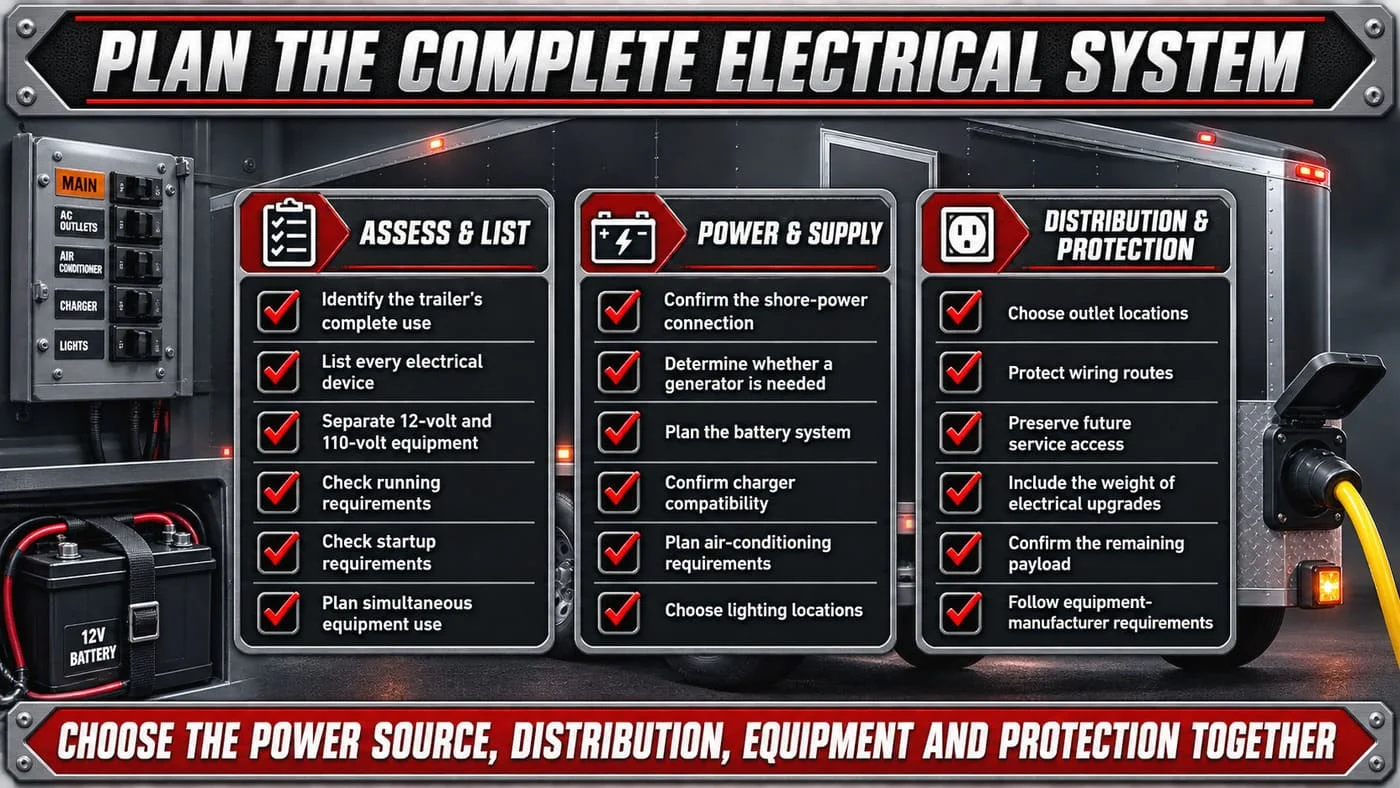
Before You Choose an Electrical Package
Confirm the following before ordering:
- ✓Identify the trailer’s complete use
- ✓List every electrical device
- ✓Separate 12-volt and 110-volt equipment
- ✓Calculate the expected electrical demand
- ✓Consider startup requirements
- ✓Decide whether shore power will be available
- ✓Determine whether a generator is needed
- ✓Plan the battery system
- ✓Confirm charger compatibility
- ✓Plan air-conditioning requirements
- ✓Choose lighting locations
- ✓Choose outlet locations
- ✓Plan breaker and fuse-panel access
- ✓Protect wiring routes
- ✓Preserve future service access
- ✓Include the weight of electrical upgrades
- ✓Confirm the remaining payload
- ✓Follow equipment-manufacturer requirements
Frequently Asked Questions
What is the difference between a 12-volt and 110-volt trailer system?
A 12-volt DC system normally operates selected equipment from a battery. A 110- or nominal 120-volt AC system generally operates through shore power or a generator and may supply outlets, air conditioning and other higher-demand equipment.
Can a trailer have both 12-volt and 110-volt power?
Yes. Many finished enclosed trailers use both systems. For example, the lighting may operate on 12-volt power while the outlets and air conditioner operate from the 110-volt package.
Does a 110-volt package include a battery?
Not necessarily. Electrical packages and included components vary. Confirm whether the trailer includes a battery, converter or charger, fuse panel, breaker panel and shore-power equipment.
Does a trailer battery power the electrical outlets?
Not unless the trailer has an appropriately designed inverter system. Standard AC outlets usually require shore power or generator power.
Will the tow vehicle charge the trailer battery?
Some trailer connections may provide an auxiliary charging circuit, but the available charging performance depends on the tow vehicle, connector, wiring and trailer system. Do not assume the tow vehicle connection will fully recharge every trailer battery configuration.
Is the breakaway battery the same as the accessory battery?
Not always. The breakaway battery is part of the emergency braking system. A trailer may use a separate battery for interior lights, a winch or other accessories.
What size generator does an enclosed trailer need?
Generator size depends on the combined electrical load and the startup requirements of the installed equipment. Air conditioning, compressors and other motor-driven equipment may require more power during startup. Follow the equipment manufacturers’ specifications.
Can air conditioning be added later?
It may be possible, but the roof opening, structural bracing, wiring, circuit capacity and power source must support the installation. Planning the air conditioner during the original build is generally more practical.
Does insulation reduce the electrical requirements?
Insulation can help manage heat transfer, but it does not eliminate the need for properly sized climate-control and electrical equipment.
Who should install or modify trailer wiring?
Electrical work should be completed by a qualified person familiar with trailers, mobile electrical systems and the requirements of the installed equipment. Follow applicable electrical requirements and manufacturer instructions.
Build the Electrical System Around the Job
The right electrical package is not determined by the number of outlets, lights or batteries alone.
The trailer size, intended use, equipment load, insulation, air conditioning, battery system, shore-power connection and generator capacity must work together.
Planning the entire system before construction can improve equipment placement, wiring protection, service access and everyday usability.
Southern Trailer Depot can help you compare electrical and interior options for cargo trailers, contractor trailers, race trailers, car haulers and custom builds.
Related Trailer Buyer’s Guides
Plan Your Enclosed Trailer Electrical Package
Tell Southern Trailer Depot how you plan to use the trailer, what equipment you need to operate and whether you expect to use shore power, battery power or a generator.
We can help you compare trailer sizes, electrical options, insulation, air conditioning, interior finishes and equipment placement.
This guide provides general educational information. Electrical systems, available options and installation requirements vary by trailer and equipment. Always verify the completed trailer’s specifications and follow the instructions supplied by the trailer manufacturer, electrical-component manufacturers and equipment manufacturers.