

Enclosed Car Hauler Trailer Buying Guide: Sizes, Weight, Loading & Options
Buying an enclosed car hauler is about more than choosing a trailer that looks large enough for your vehicle. The right trailer must provide sufficient usable interior space, safe loading clearance, properly rated axles and tires, adequate payload capacity, and a secure way to transport your car.
Whether you're hauling a classic car, sports car, race car, show vehicle, or restoration project, choosing the right enclosed trailer helps protect your investment while making loading, unloading, and transportation more practical.
At Southern Trailer Depot in Douglas, Georgia, we've helped customers find and configure trailers since 2007.
This guide explains the most important things to evaluate before purchasing an enclosed car hauler.
1. What Size Enclosed Car Hauler Do You Need?
The first step is measuring the vehicle you intend to transport.
Vehicle length alone does not determine the right trailer size. You must also account for vehicle width, height, loading clearance, tie-down locations, interior wheel boxes, and space needed to move safely around the vehicle.
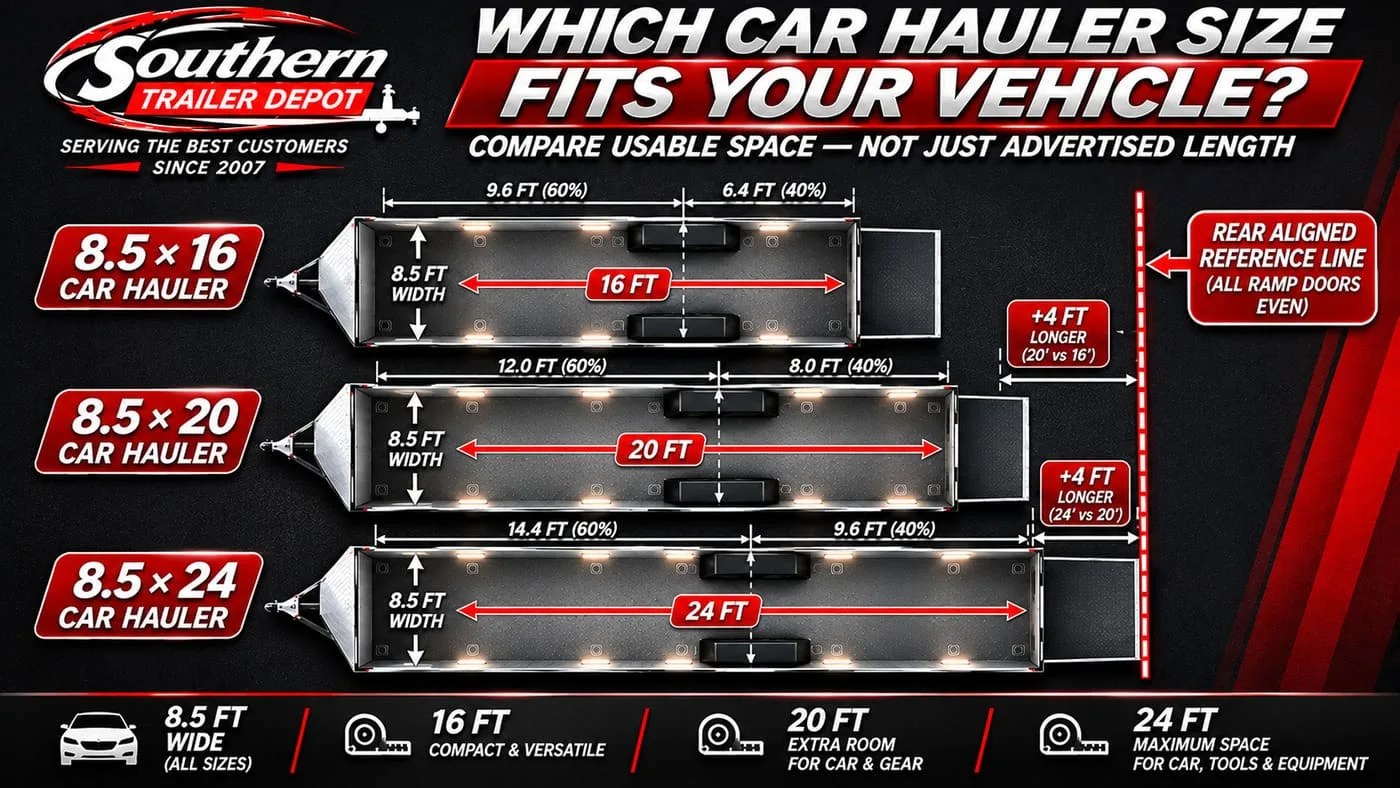
Common enclosed car hauler sizes include:
8.5×16 Enclosed Car Hauler
An 8.5×16 trailer may work for certain compact vehicles, smaller race cars, and other shorter loads.
However, 16 feet of advertised trailer length does not guarantee 16 feet of unobstructed usable floor space. The actual vehicle must be measured, and sufficient room must remain for securement.
8.5×20 Enclosed Car Hauler
An 8.5×20 is a popular option for buyers who need additional length without moving into a larger trailer.
It can be suitable for many passenger cars, sports cars, and motorsports applications when the actual vehicle dimensions, trailer opening, and payload are compatible.
8.5×24 Enclosed Car Hauler
An 8.5×24 provides additional body length that may be useful for larger vehicles, tool storage, spare tires, race equipment, and custom interior features.
The extra space can improve loading flexibility, but a longer trailer also requires consideration of turning clearance, parking space, empty weight, and towing capacity.
Larger Custom Car Haulers
For customers transporting larger vehicles, multiple pieces of equipment, or extensive race-support gear, longer and heavier-duty configurations may be appropriate.
Available sizes and axle packages depend on the manufacturer and trailer configuration.
Important: Advertised trailer dimensions are not a substitute for measuring the actual usable interior space.
2. Measure Your Vehicle Before Choosing a Trailer
Before shopping, record the following vehicle measurements:
- ✓Overall length, including spoilers and accessories.
- ✓Overall width, including mirrors where applicable.
- ✓Overall height, including roof-mounted equipment.
- ✓Front and rear ground clearance.
- ✓Wheelbase and tire width.
- ✓Vehicle curb weight and actual transport weight.
- ✓Position of the driver's door.
- ✓Space required for loading and tie-down access.
Compare those measurements with the actual trailer's interior dimensions and rear-door clear opening.
Remember that mirrors, spoilers, splitters, side skirts, wide tires, and suspension modifications can affect fitment.
A vehicle may fit inside the trailer but still be difficult or unsafe to load.

3. Understand GVWR, Empty Weight and Payload
Three weight measurements are essential when choosing an enclosed car hauler.
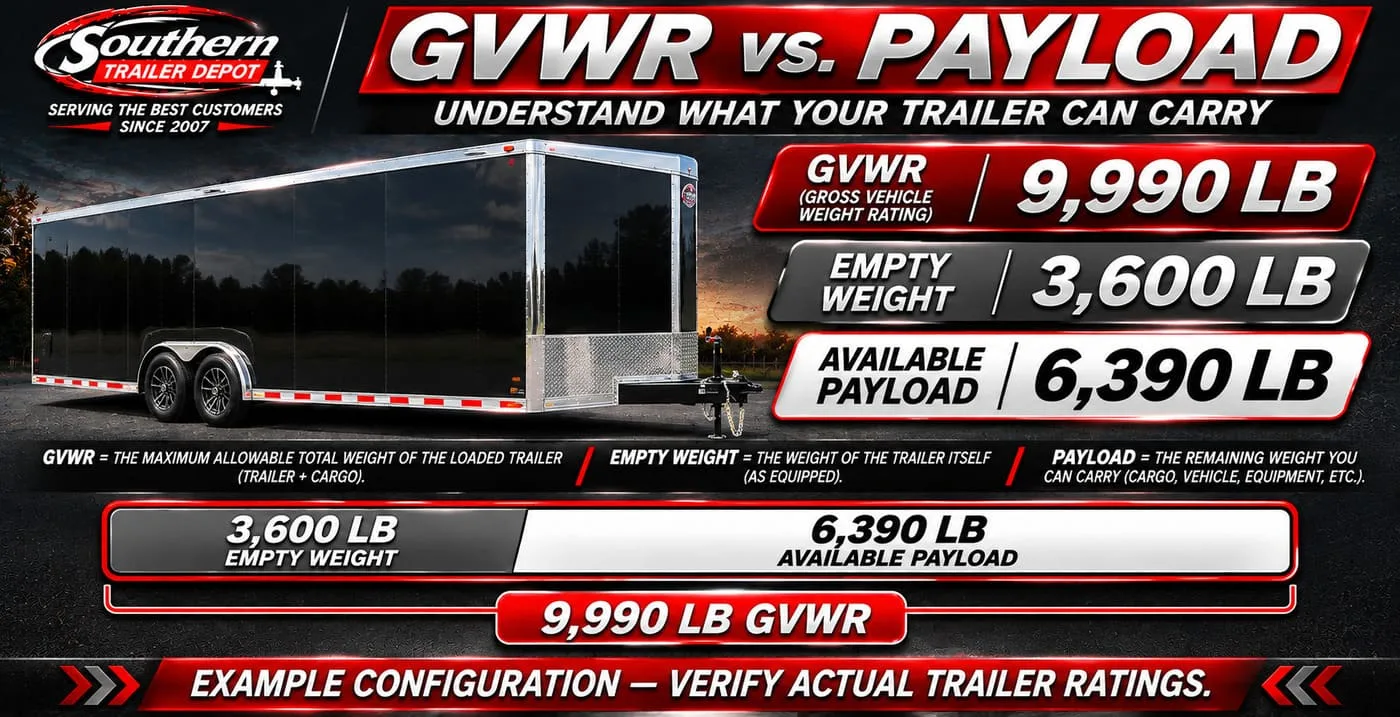
Gross Vehicle Weight Rating (GVWR) is the manufacturer's certified maximum allowable loaded trailer weight.
Empty weight is the weight of the trailer before adding cargo, with the exact value depending on its construction and installed equipment.
Available payload is the difference between the certified GVWR and the trailer's actual empty weight.
For example:
| Measurement | Example |
|---|---|
| Certified GVWR | 9,990 lb |
| Trailer empty weight | 3,600 lb |
| Available payload | 6,390 lb |
This is an illustrative configuration, not a rating that applies to every 8.5×24 trailer.
Your vehicle, tools, spare parts, fuel containers, cabinets, winches, and other cargo all contribute to the loaded trailer weight.
Installed upgrades also increase empty weight and may reduce available payload.
Never assume that adding heavier axles automatically increases the trailer's certified GVWR.
4. Choose the Correct Axle Package
Axle selection should be based on the trailer's actual weight, certified ratings, intended cargo, and operating requirements.
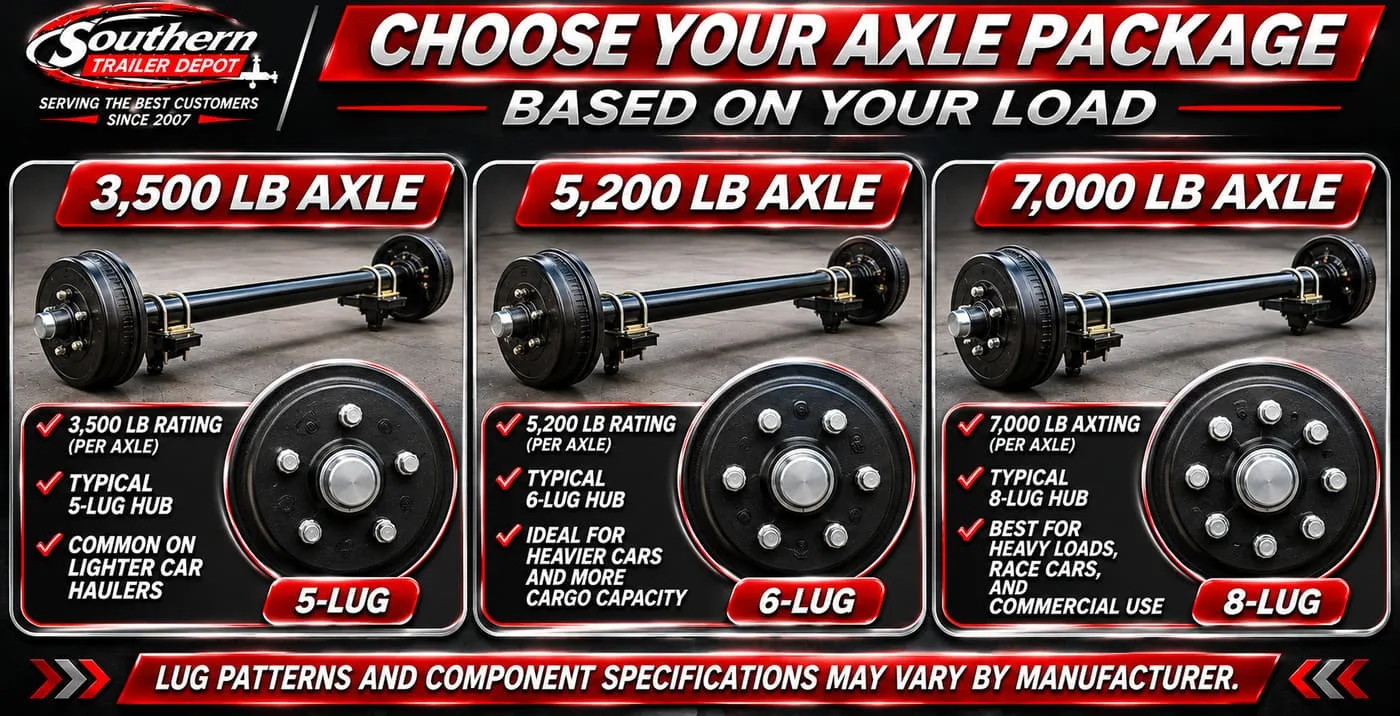
Common nominal axle ratings include 3,500 lb, 5,200 lb, and 7,000 lb per axle.
A 3,500 lb axle commonly uses a five-lug wheel, a 5,200 lb axle commonly uses a six-lug wheel, and a 7,000 lb axle commonly uses an eight-lug wheel.
Actual specifications vary by manufacturer.
Axle capacity is only one part of the trailer's overall weight-rating system.
Tires, wheels, suspension, frame construction, brakes, and the manufacturer's certified GVWR must also be considered.
5. Rear Ramp Clearance and Loading Angle
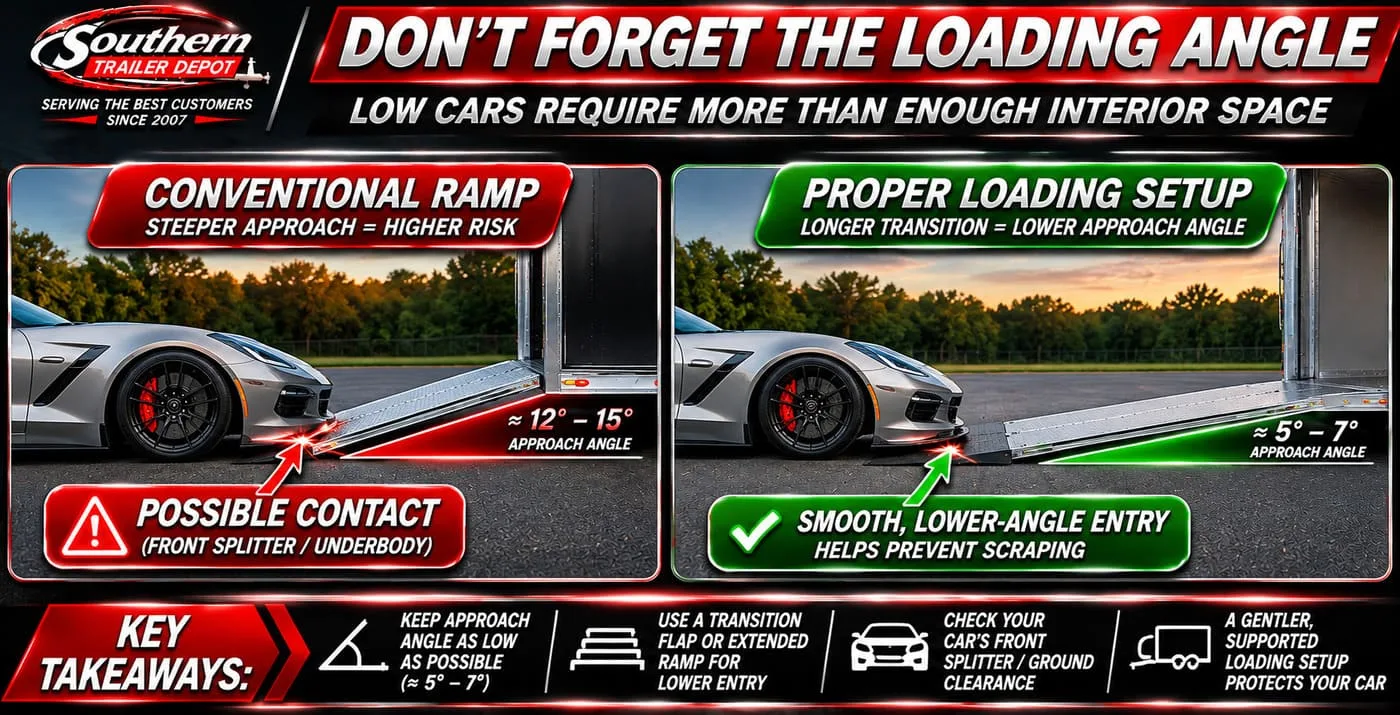
One of the most important considerations for sports cars and low-clearance vehicles is the loading ramp.
A trailer can have enough interior room for a car while still presenting loading difficulties because of its ramp angle.
Low front splitters, spoilers, side skirts, and long wheelbases can create clearance problems.
Before purchasing, evaluate:
- ✓Rear-door clear width and height.
- ✓Trailer deck height.
- ✓Ramp length and slope.
- ✓Transition flap design.
- ✓Vehicle approach and departure angles.
- ✓Breakover clearance.
- ✓Available loading surface.
Some trailers can be configured with extended transition flaps, specialized ramps, or other loading accessories.
Always verify compatibility with the vehicle being transported.
6. Do You Need a Driver-Side Escape Door?
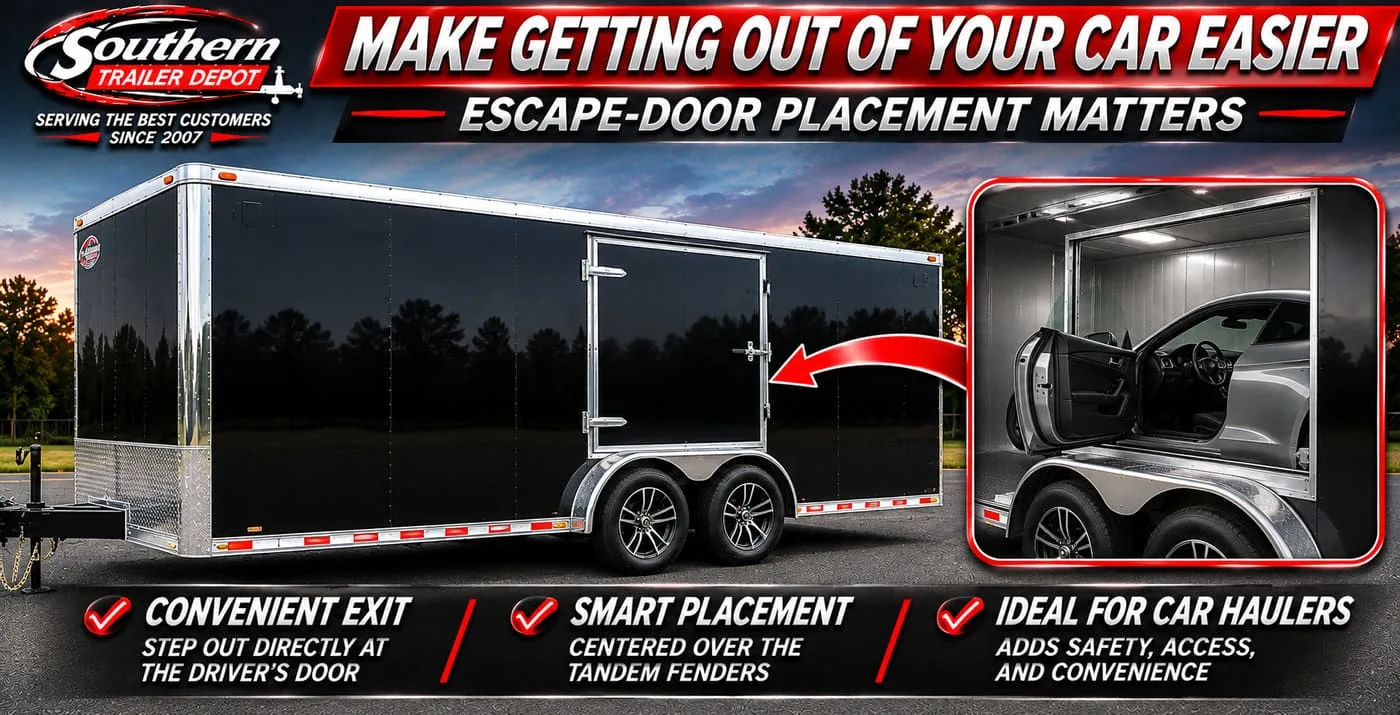
An escape door can make loading and unloading a vehicle much more convenient.
When a car is parked inside an enclosed trailer, there may not be enough room to open its driver's door fully.
A properly positioned escape door can provide access to the vehicle's door and allow the driver to exit without squeezing between the car and trailer wall.
However, not all escape doors work with all vehicles.
Important considerations include:
- ✓Door placement relative to the vehicle.
- ✓Height of the vehicle's door sill.
- ✓Wheel-box and fender position.
- ✓Opening dimensions.
- ✓Trailer floor height.
- ✓Availability of a removable fender or step.
The escape-door location should be selected around the actual vehicle rather than assumed to work universally.
7. Tie-Downs, E-Track and Vehicle Securement
Proper cargo securement is essential when transporting vehicles.
Common car-hauler securement equipment includes recessed D-rings, floor-mounted E-Track, wheel straps, appropriately rated tie-down straps, and manufacturer-approved anchor points.
The best arrangement depends on the vehicle's weight, wheel placement, suspension, and recommended securement method.
Anchor points must be rated and attached to suitable structural supports.
Do not assume that decorative floor hardware or an unverified attachment point is suitable for securing a vehicle.
Follow applicable cargo-securement requirements and the recommendations of the trailer, vehicle, and tie-down manufacturers.

8. Match the Trailer to Your Tow Vehicle
A properly configured car hauler must also be compatible with the tow vehicle.
Before purchasing, confirm:
- ✓Maximum trailer weight rating.
- ✓Gross Combined Weight Rating (GCWR).
- ✓Tow-vehicle payload.
- ✓Actual loaded tongue weight.
- ✓Hitch and receiver ratings.
- ✓Required weight-distribution equipment, if applicable.
- ✓Brake-controller compatibility.
- ✓Trailer brake operation.
- ✓Tire and axle ratings.
Tongue weight is part of the load carried by the tow vehicle and must be accounted for when evaluating payload and axle ratings.
Do not rely exclusively on the truck's advertised maximum towing capacity.
Actual ratings depend on the vehicle's specific configuration and manufacturer documentation.

9. Popular Custom Enclosed Car Hauler Upgrades
An enclosed car hauler can be customized around the vehicle, loading process, and equipment you need to transport.
Popular upgrades may include:
- ✓Smooth PolyCore exterior panels.
- ✓Blackout trim and wheels.
- ✓Driver-side escape doors.
- ✓Extended loading ramps or transition flaps.
- ✓Rear spoilers with LED loading lights.
- ✓Recessed D-rings and floor E-Track.
- ✓Electric winches and reinforced winch mounting.
- ✓Rubber coin flooring.
- ✓Finished aluminum interior walls.
- ✓Aluminum tread plate trim.
- ✓Overhead cabinets.
- ✓Interior LED lighting.
- ✓Electrical packages and outlets.
- ✓Air conditioning.
- ✓Insulation.
- ✓Spare-tire storage.
- ✓Electric tongue jacks.
Custom options depend on trailer size, manufacturer, structural requirements, and available build configurations.
Remember that every installed upgrade can affect trailer weight and available payload.

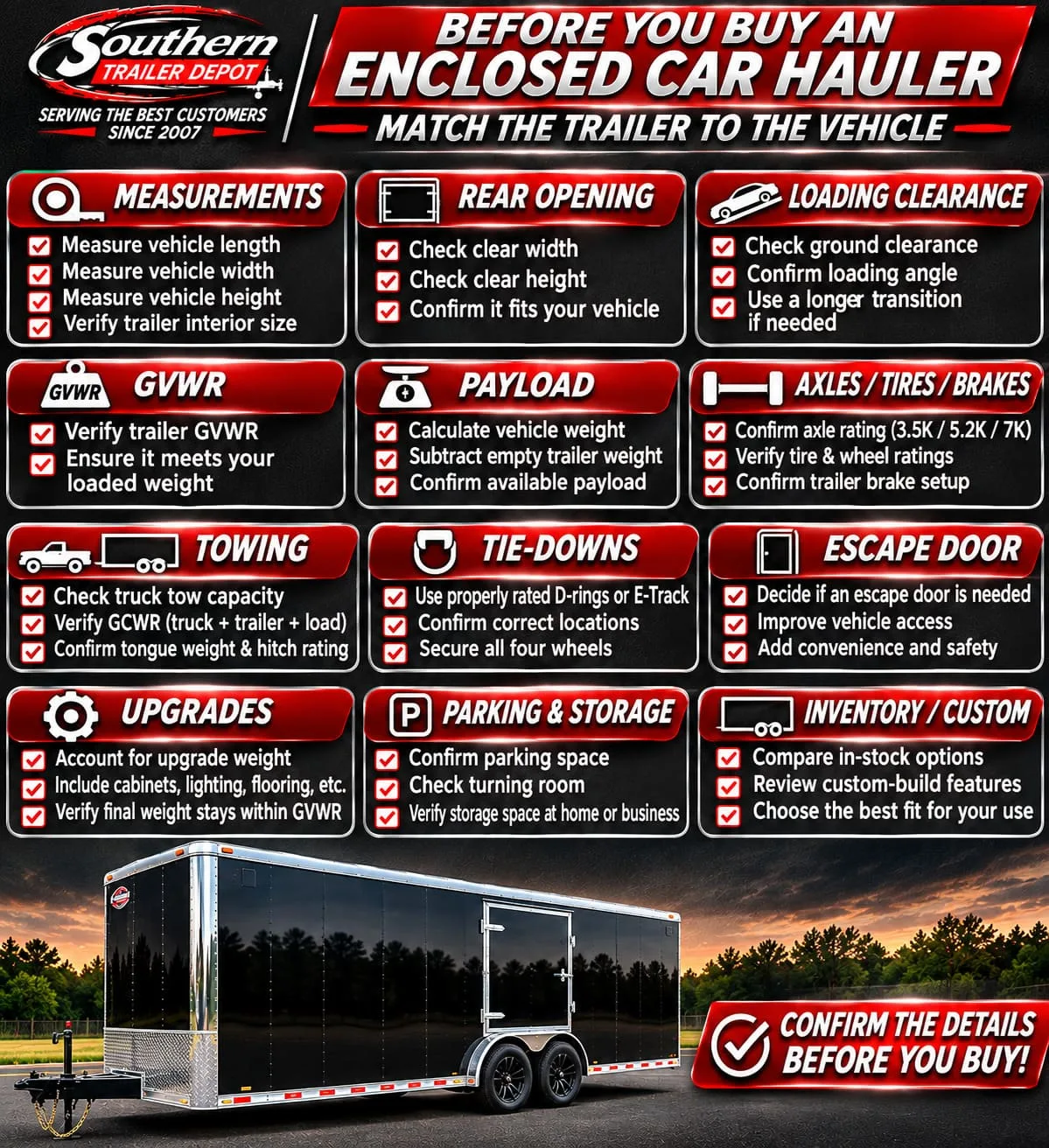
10. Enclosed Car Hauler Buying Checklist
Frequently Asked Questions About Enclosed Car Haulers
What size enclosed trailer do I need to haul a car?
The correct size depends on your vehicle's dimensions and weight, along with the trailer's usable interior space, rear-door opening, wheel-box clearance, and payload. Common choices include 8.5×16, 8.5×20, and 8.5×24 configurations, but every vehicle and trailer combination must be checked individually.
Is an 8.5×20 enclosed trailer long enough for a car?
An 8.5×20 can accommodate many vehicles, but compatibility depends on the car's actual length and the space required for securement and loading. Verify the trailer's usable interior dimensions before purchasing.
Is an 8.5×24 better than an 8.5×20?
An 8.5×24 provides four additional feet of advertised body length. That space can be valuable for tools, spare tires, equipment, and loading flexibility. However, a longer trailer may cost more, weigh more, and require additional parking or maneuvering space.
Can a low sports car be loaded into an enclosed trailer?
Many low-clearance vehicles can be transported in appropriately configured enclosed trailers, but the loading ramp, transition angle, deck height, and vehicle clearance must be evaluated. Never assume that every low car can use a standard ramp without modifications.
How much weight can an enclosed car hauler carry?
Payload varies depending on the trailer's certified Gross Vehicle Weight Rating (GVWR), actual empty weight, axle configuration, and installed equipment.
To calculate available payload, subtract the trailer's actual empty weight from its certified GVWR.
Example:
- Certified GVWR: 9,990 lbs
- Empty trailer weight: 3,600 lbs
- Available payload: 6,390 lbs
This is an example configuration, not a guaranteed capacity for every enclosed car hauler.
Buyers should verify the trailer's certification label, actual weight, tire and axle ratings, and installed equipment before loading. Proper weight distribution and tow-vehicle limits must also be considered.
What size enclosed trailer is best for hauling a car?
The best enclosed car hauler size depends on the vehicle's dimensions, weight, and the additional equipment you plan to transport.
Common options include:
8.5×16 Enclosed Car Hauler
A compact option for appropriately sized vehicles when interior length, rear opening, wheel-box clearance, and payload are sufficient.
8.5×20 Enclosed Car Hauler
A popular option for sports cars, classic cars, and performance vehicles. The additional length can provide more flexibility for positioning the vehicle and carrying equipment.
8.5×24 Enclosed Car Hauler
A larger option for race cars, longer vehicles, and customers who need additional room for tools, spare tires, cabinets, or motorsports equipment.
Always compare usable interior dimensions rather than relying solely on advertised trailer size.
Will a Corvette fit inside an enclosed car hauler?
Many Corvette models can fit inside appropriately configured 8.5-foot-wide enclosed car haulers, but compatibility depends on the specific Corvette and trailer.
Before purchasing, verify:
- Overall vehicle length and width, including mirrors
- Vehicle height and ground clearance
- Clear rear-door opening
- Interior width between wheel boxes
- Ramp angle and transition clearance
- Trailer payload and tie-down locations
Lower sports cars may require a longer ramp transition or other properly supported loading equipment to prevent front-splitter or underbody contact.
Do I need an escape door on my enclosed car hauler?
An escape door can make entering and exiting a vehicle easier after it has been loaded into an enclosed trailer.
For many car-hauling applications, a driver-side escape opening positioned above the tandem fender area can provide access to the vehicle's driver-side door.
However, the opening must align with the specific vehicle's door position and height.
Escape-door dimensions, placement, hinges, and framing should be confirmed before ordering a custom trailer.
What is the difference between 5,200 lb and 7,000 lb trailer axles?
A 5,200 lb axle has a nominal axle rating of 5,200 lbs, while a 7,000 lb axle has a nominal axle rating of 7,000 lbs.
A tandem-axle configuration may have two axles of the same rating, but the combined axle ratings do not automatically establish the trailer's certified GVWR or available payload.
Heavier axle packages may be appropriate for heavier cargo and certain upgraded configurations.
Buyers should also verify tire capacity, wheel ratings, brakes, suspension, frame construction, and the manufacturer's certified GVWR.
Can I haul a low-clearance sports car in an enclosed trailer?
Yes, provided the trailer and loading arrangement are compatible with the vehicle.
Low-clearance sports cars require special attention to the loading approach angle, ramp transition, vehicle wheelbase, and front and rear overhang.
A trailer may have sufficient interior dimensions but still create loading problems if the approach angle is too steep.
Longer, properly supported loading ramps, transition flaps, or other manufacturer-approved loading solutions may help reduce scraping.
Always verify actual clearance before loading.
What type of tie-down system is best for an enclosed car hauler?
Common vehicle securement options include recessed floor D-rings, floor-mounted E-Track, and properly rated wheel-strap systems.
The correct system depends on the vehicle, anchor locations, trailer construction, and cargo weight.
A properly designed four-wheel securement arrangement can help restrain the vehicle during transportation.
Use rated straps and anchors according to their manufacturers' instructions and applicable cargo-securement requirements. Never attach straps to unsupported interior trim or nonstructural components.
Can I customize an enclosed car hauler?
Yes. Southern Trailer Depot offers enclosed trailers with a variety of available configurations and custom-build options.
Depending on the manufacturer and trailer model, available upgrades may include:
- Smooth PolyCore exterior panels
- Blackout packages and upgraded wheels
- Driver-side escape doors
- Rear spoilers with LED loading lights
- Floor E-Track and recessed D-rings
- Finished aluminum interiors
- Overhead cabinets and workbenches
- Additional interior LED lighting
- Rubber coin flooring
- Heavy-duty ramps and transition flaps
- Upgraded axle and suspension packages
Availability and compatibility vary by manufacturer and model.
What truck do I need to tow an enclosed car hauler?
The correct tow vehicle depends on the trailer's actual loaded weight, tongue weight, hitch requirements, and the tow vehicle's specific ratings.
Before towing, verify:
- Maximum trailer towing capacity
- Gross Combined Weight Rating (GCWR)
- Truck payload capacity
- Gross Vehicle Weight Rating (GVWR) of the truck
- Receiver, ball mount, and hitch-ball ratings
- Expected tongue weight
- Trailer brake compatibility
Do not assume that every heavy-duty pickup can safely tow every enclosed car hauler.
The truck, hitch, trailer, and loading configuration must all be compatible.
Where can I buy an enclosed car hauler in Georgia?
Southern Trailer Depot in Douglas, Georgia, offers enclosed cargo trailers and car-hauling configurations for customers transporting sports cars, classic vehicles, race cars, and motorsports equipment.
Serving customers since 2007, Southern Trailer Depot helps buyers compare available inventory, trailer dimensions, axle packages, towing requirements, and custom upgrades.
Whether you're shopping for an 8.5×16, 8.5×20, or 8.5×24 enclosed car hauler, our sales team can help you explore available options.
Call Southern Trailer Depot: 1-888-403-1902
Find the Right Enclosed Car Hauler at Southern Trailer Depot
Buying an enclosed car hauler involves more than choosing a trailer that looks large enough for your vehicle.
Interior dimensions, loading clearance, payload, axle configuration, tie-down locations, and towing compatibility all influence which trailer will best serve your needs.
At Southern Trailer Depot, we help customers evaluate these important details before making a purchase.
Shop Enclosed Car Haulers and Custom Trailers
Whether you're transporting a Corvette, classic muscle car, race car, or another valuable vehicle, Southern Trailer Depot can help you compare available trailer options.
Explore:
- ✓8.5×16 enclosed trailers
- ✓8.5×20 enclosed trailers
- ✓8.5×24 enclosed trailers
- ✓Car-hauling configurations
- ✓Custom-built enclosed trailers
- ✓Premium motorsports and race trailer upgrades
CALL FOR AVAILABILITY OR A CUSTOM QUOTE
Southern Trailer Depot — Serving the Best Customers Since 2007.